

Quality Assurance and Quality Control are two of the most important parts of any Quality Management System.
However, they are also two of the most commonly confused terms in construction.
People use QA and QC interchangeably, job titles are not always consistent and many construction companies simply combine everything under the heading of “QA/QC”.
But Quality Assurance and Quality Control are not exactly the same thing.
Quality Assurance is mainly about preventing problems by establishing the right processes, responsibilities and controls.
Quality Control is mainly about checking the actual work and identifying whether it meets the specified requirements.
A construction project needs both.
You cannot inspect quality into a project if the work was not properly planned in the first place. At the same time, a perfect Quality Plan and a folder full of approved procedures do not prove that the finished work is actually compliant.
In this guide, I will explain the difference between Quality Assurance and Quality Control, give practical construction examples and show how QA and QC should work together as part of an effective construction quality management system.
What is Quality Assurance?
Quality Assurance, usually shortened to QA, is the planned and systematic way an organisation makes sure that its processes are capable of producing work that meets the requirements.
In simple words, Quality Assurance is about setting up the project properly so that problems are less likely to happen.
It focuses mainly on the process rather than the finished product.
Typical Quality Assurance activities in construction include:
- Reviewing the contract, drawings and technical specifications.
- Preparing the Project Quality Plan.
- Defining quality roles, responsibilities and authorities.
- Preparing Method Statements and quality procedures.
- Developing Inspection and Test Plans.
- Identifying risks and establishing suitable controls.
- Evaluating suppliers and subcontractors.
- Confirming that people are competent and properly trained.
- Controlling drawings, specifications and other project documents.
- Planning internal audits and management reviews.
- Establishing systems for reporting and managing nonconformities.
- Reviewing performance data and lessons learned.
For example, preparing an Inspection and Test Plan before an activity begins is a Quality Assurance activity.
The ITP defines what needs to be inspected, who is responsible, which acceptance criteria apply, when Hold Points or Witness Points occur and which records need to be completed.
It does not guarantee that the work will be correct. However, it creates a controlled process for verifying the work at the right stages.
The same principle applies to Method Statements, supplier evaluations, competence checks and the control of construction documents and drawings.
These controls are established before or throughout the work to reduce the likelihood of something going wrong.
What is Quality Control?
Quality Control, usually shortened to QC, is the inspection, testing, measurement and verification of the actual work or material.
In simple words, Quality Control is about checking whether the required result has been achieved.
It focuses mainly on the constructed work, installed material or completed service.
Typical Quality Control activities in construction include:
- Inspecting reinforcement before a concrete pour.
- Checking dimensions, levels, tolerances and alignment.
- Reviewing material delivery certificates.
- Witnessing concrete slump tests and cube sampling.
- Checking welding and non-destructive testing results.
- Inspecting waterproofing before it is covered.
- Testing electrical, mechanical and drainage systems.
- Completing checksheets and inspection records.
- Witnessing Hold Points and Witness Points.
- Inspecting completed work for defects.
- Raising a Non-Conformance Report when requirements have not been met.
- Verifying that repaired or corrected work is acceptable.
Quality Control needs a defined requirement against which the work can be checked.
That requirement might come from:
- An approved design drawing.
- A technical specification.
- The contract.
- A code or technical standard.
- An approved material submission.
- A Method Statement.
- An Inspection and Test Plan.
- A manufacturer’s installation instructions.
- An approved response to a Request for Information.
If the requirement is not clear, the inspector cannot make a reliable acceptance decision.
This is one of the reasons why QA and QC cannot operate independently. Quality Assurance establishes and communicates the controls, while Quality Control checks the result against those controls.
Quality Assurance vs Quality Control: the main differences
The simplest way to understand the difference is this:
Quality Assurance tries to prevent the problem. Quality Control tries to identify the problem.
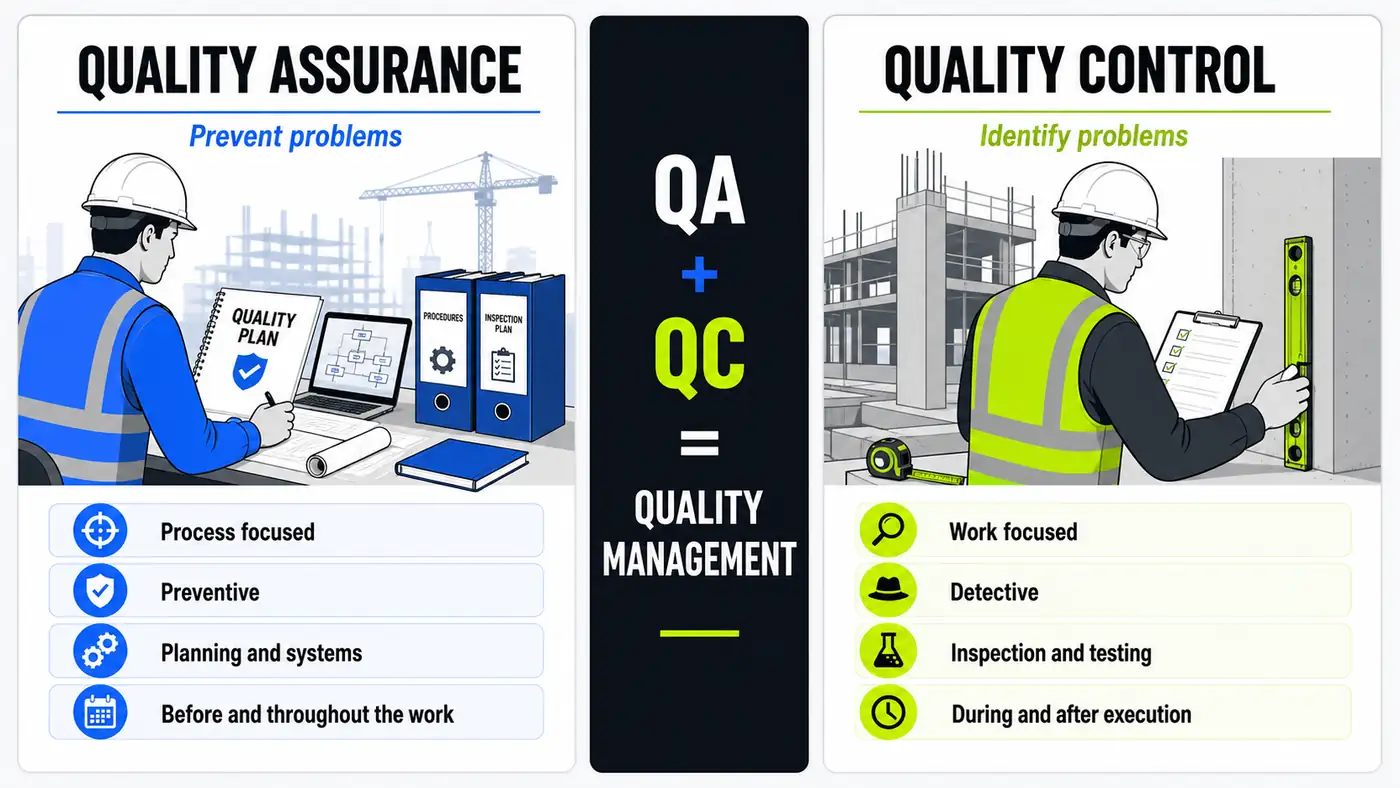
| Quality Assurance | Quality Control |
|---|---|
| Process focused | Work or product focused |
| Primarily preventive | Primarily detective |
| Establishes how the work will be controlled | Checks whether the work meets the requirements |
| Begins before construction starts | Occurs during and after construction |
| Includes plans, processes, procedures and responsibilities | Includes inspections, tests, measurements and records |
| Reduces the likelihood of defects | Identifies defects and nonconforming work |
| Reviews whether the system is suitable | Verifies whether the output is acceptable |
| Normally applies across the project or organisation | Often applies to a specific activity, location or item of work |
This does not mean that QA only happens before the work or that QC only happens at the end.
Quality Assurance continues throughout the project through audits, performance reviews, procedure updates, competence management and lessons learned.
Quality Control also begins before work is completely finished. Many construction inspections have to happen while the work is in progress or immediately before it is covered.
Reinforcement, waterproofing, drainage, fire stopping and embedded items are obvious examples. Waiting until the end may make a meaningful inspection impossible.
Quality Assurance and Quality Control examples in construction
The difference becomes much clearer when we look at real construction activities.
Example 1: Concrete works
Before concrete is poured, the Quality Assurance activities may include:
- Reviewing the concrete specification.
- Approving the concrete supplier and mix design.
- Preparing the concrete Method Statement.
- Preparing an ITP for concrete works.
- Establishing Hold Points and inspection responsibilities.
- Confirming the required sampling and testing frequencies.
- Checking the competence of the people performing the tests.
- Confirming that testing equipment is calibrated.
- Ensuring the latest approved drawings are available on site.
These are mainly preventive controls. They organise the activity before the concrete arrives.
The Quality Control activities may then include:
- Checking reinforcement size, spacing and position.
- Checking cover blocks, formwork and embedded items.
- Inspecting cleanliness before the pour.
- Checking the concrete delivery ticket and approved mix reference.
- Measuring concrete temperature and workability.
- Carrying out a slump test.
- Taking concrete samples for strength testing.
- Monitoring placement, vibration and finishing.
- Recording the inspection and test results.
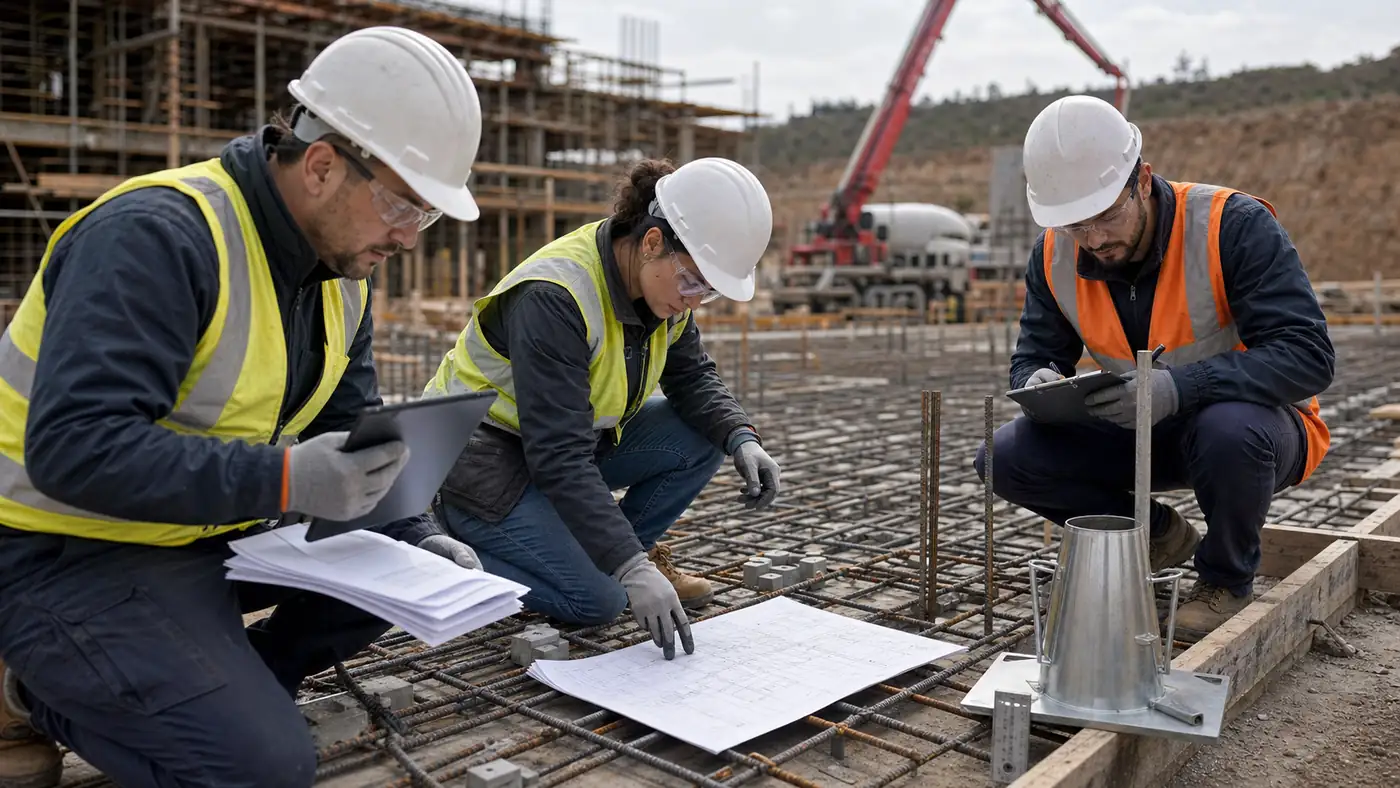
The approved ITP is Quality Assurance. Following the ITP and recording the inspection results is Quality Control.
Both are required.
A concrete slump test without an approved mix, defined acceptance criteria or calibrated equipment is not effective control. Equally, an approved ITP is useless if the inspections are skipped or the results are not recorded.
Example 2: Waterproofing works
Quality Assurance may include approving the waterproofing system, reviewing manufacturer requirements, preparing the Method Statement, training the installers and agreeing the inspection stages.
Quality Control may include checking surface preparation, overlaps, terminations, penetrations, applied thickness and the results of integrity testing.
The Quality Assurance system should make sure the inspector is called before the waterproofing is covered.
The Quality Control inspection should confirm whether the installed system is acceptable.
Example 3: Structural steelwork
Quality Assurance may include:
- Evaluating the fabricator.
- Approving welding procedures.
- Confirming welder qualifications.
- Preparing the fabrication and erection ITP.
- Defining inspection and testing frequencies.
- Establishing material traceability requirements.
Quality Control may include:
- Checking material certificates and identification.
- Inspecting weld preparation and completed welds.
- Witnessing non-destructive testing.
- Checking bolt installation and tightening.
- Measuring line, level and alignment.
- Inspecting protective coatings.
Example 4: Document control
A documented process for issuing, reviewing, approving and distributing drawings is a Quality Assurance control.
Checking that the supervisor is using the latest approved drawing at the point of construction is a Quality Control activity.
Poor document control on a construction site can destroy both systems.
The project may have excellent procedures and competent inspectors, but if an outdated drawing is being used, the work could still be incorrect.
Example 5: Nonconforming work
Establishing a procedure for reporting, assessing, correcting and closing nonconforming work is part of Quality Assurance.
Identifying the nonconforming work during an inspection and raising a report is Quality Control.
The complete construction NCR process then connects control with improvement.
The immediate correction deals with the affected work. Root-cause analysis and corrective action should address why the failure happened and reduce the chance of it happening again.
This distinction is explained in more detail in the guide to ISO 9001 nonconformity and corrective action.
How Quality Assurance and Quality Control work together
Quality Assurance and Quality Control should not be treated as two competing departments.
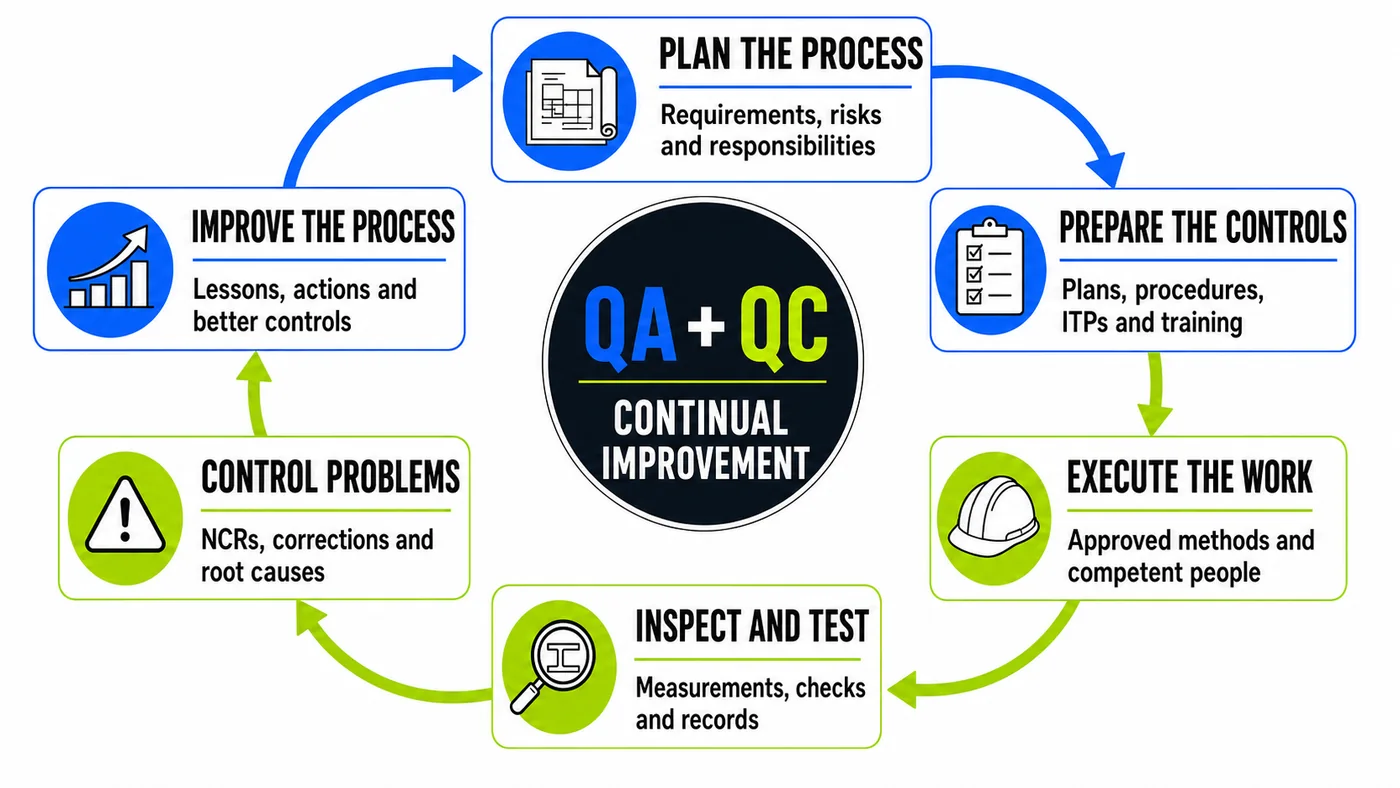
They are parts of the same quality-management cycle.
- The project identifies the requirements and risks.
- Plans, procedures, ITPs and responsibilities are established.
- The work is completed using the approved methods.
- The work is inspected and tested.
- Problems are controlled and corrected.
- Results, trends and causes are reviewed to improve the process.
Imagine that repeated inspections find incorrectly positioned reinforcement cover blocks.
Quality Control identifies the problem, records the evidence and prevents the concrete pour from proceeding until the issue has been corrected.
Quality Assurance should then look beyond that individual inspection.
Why is the same problem happening repeatedly?
Possible causes may include:
- The drawing is not clear.
- The Method Statement does not explain the requirement.
- The reinforcement team has not been properly briefed.
- The correct cover blocks are not available.
- The inspection is taking place too late.
- Responsibilities are not understood.
- The subcontractor is under excessive programme pressure.
Correcting the cover blocks resolves the immediate QC issue.
Improving the briefing, supply process, method or inspection timing strengthens Quality Assurance.
This is how the project learns rather than simply repairing the same problem again and again.
Who is responsible for Quality Assurance and Quality Control?
Quality is not the responsibility of the Quality Manager alone.
Everyone whose decisions or work can affect the final result has a quality responsibility.
Senior management
Senior management establishes the organisation’s direction, provides resources, assigns responsibilities and creates the culture in which problems are either reported honestly or hidden.
A project will struggle if management supports quality only when it does not affect cost or programme.
Project Manager
The Project Manager should ensure that quality requirements are incorporated into project planning and delivery.
This includes resources, design coordination, procurement, subcontractor management, programme allowances, inspection arrangements and the resolution of significant problems.
Quality Manager or QA/QC Manager
The Quality Manager normally coordinates the Quality Management System and provides specialist support.
Typical responsibilities may include:
- Preparing or maintaining the Project Quality Plan.
- Reviewing procedures, Method Statements and ITPs.
- Monitoring compliance with project controls.
- Planning and conducting quality audits.
- Monitoring NCRs and corrective actions.
- Reporting quality performance.
- Identifying trends and improvement opportunities.
The Quality Manager should not become the person who personally checks every activity on the project.
That approach removes responsibility from the people delivering the work and is impossible on a large construction site.
Site engineers and supervisors
Site engineers and supervisors are usually closest to the work.
They should understand the drawings, specifications, Method Statements and ITP requirements. They should coordinate inspections, check the work progressively and make sure activities do not proceed beyond required Hold Points.
They also need to raise an RFI when requirements are unclear rather than making an undocumented assumption on site.
Quality inspectors
Quality inspectors verify the work, record objective evidence, identify nonconformities and confirm whether acceptance criteria have been met.
They need appropriate technical knowledge, access to current documentation and enough independence to report problems honestly.
Subcontractors and operatives
The people carrying out the work are responsible for following the approved method and checking their own work.
An inspector should not be the first person to discover every basic defect.
Effective Quality Control begins with self-inspection by the team completing the activity, followed by the contractor’s inspection and any required Client or third-party verification.
Quality Assurance, Quality Control and ISO 9001
ISO 9001 does not divide its requirements into separate QA and QC departments.
Instead, it establishes requirements for a complete Quality Management System.
This includes:
- Understanding the organisation and its interested parties.
- Leadership and customer focus.
- Risk-based planning.
- Competence and awareness.
- Control of documented information.
- Operational planning and control.
- Control of suppliers and subcontractors.
- Monitoring, measurement, analysis and evaluation.
- Internal audits.
- Management review.
- Control of nonconforming outputs.
- Corrective action and continual improvement.
Some of these requirements are more closely associated with Quality Assurance, while others include obvious Quality Control activities.
But they are designed to work as one system.
My guide to ISO 9001 requirements and Clauses 4 to 10 explains the overall structure of the Standard in plain English.
For contractors, the guide to ISO 9001 for construction companies explains how company-level management processes should connect with project-level controls such as drawings, Method Statements, ITPs, inspections and handover records.
If you are starting from the beginning, follow the practical process in How to Implement ISO 9001 Step by Step.
Where do internal audits fit?
An internal audit is primarily a Quality Assurance activity because it evaluates whether the management system and its processes are properly implemented and effective.
However, the auditor may sample Quality Control evidence such as completed inspection records, test certificates, calibration records and NCRs.
A useful audit does not simply confirm that procedures exist. It checks whether those procedures are being followed and whether they produce the intended results.
The ISO 9001 internal audit guide and checklist explains how to plan the audit, collect objective evidence and report findings.
Where does performance measurement fit?
Inspection results, test failures, overdue NCRs, repeated defects, audit findings and Client complaints provide information about how the system is performing.
Projects can use this information to identify patterns and decide where additional controls are required.
However, one number should never be used in isolation.
A project with very few NCRs is not automatically a high-quality project. It may simply have a poor reporting culture.
My guide on how to measure quality in construction projects covers inspections, NCRs, document-control data, audits, handover readiness and Client satisfaction.
Common mistakes with Quality Assurance and Quality Control
1. Believing that inspection creates quality
Inspection can identify a problem, but it does not automatically prevent the problem from happening.
If the project depends entirely on final inspection, failures will be found late, after time and money have already been spent.
2. Producing procedures that nobody follows
A large collection of approved documents is not evidence of an effective Quality Management System.
The procedures must reflect the actual work, be understood by the relevant people and be available at the point of use.
3. Treating the Quality Department as responsible for all quality
This creates the dangerous belief that engineers, supervisors and subcontractors can complete the work while the Quality Department “takes care of quality”.
Quality personnel support, monitor and challenge the process. They do not replace the responsibilities of the delivery team.
4. Inspecting the work too late
Many construction activities become concealed by later work.
An effective ITP should follow the sequence of construction and identify the stages at which inspections need to occur.
5. Using outdated drawings or specifications
No inspection can be reliable if the inspector or construction team is using the wrong revision.
Current approved information needs to be available at the point of use, while superseded documents must be removed or clearly controlled.
6. Raising NCRs without learning from them
Closing an NCR after the work has been repaired does not necessarily prevent recurrence.
Significant or repeated problems should be investigated to identify their causes and establish effective corrective actions.
7. Focusing on paperwork instead of risk
Not every activity requires the same level of control.
The project should focus its resources on work where failure could have serious consequences for safety, performance, durability, compliance, programme or handover.
How to establish a practical QA/QC system in construction
A practical QA/QC system does not need to be unnecessarily complicated.
It needs to be clear, proportionate to the risks and connected to how the project is actually delivered.
Step 1: Identify the requirements
Review the contract, drawings, specifications, legislation, applicable standards and Client requirements.
If information is missing or contradictory, use the formal RFI process to obtain clarification before the work proceeds.
Step 2: Identify the quality risks
Consider what could go wrong, which work will become concealed, which materials require approval and which failures would have the greatest consequences.
This assessment should influence the Method Statements, ITPs, inspection frequencies and Hold Points.
Step 3: Define responsibilities
Make it clear who prepares documents, who reviews them, who completes the work, who performs the initial check and who provides final acceptance.
Avoid vague statements such as “the project team is responsible”.
Step 4: Prepare the necessary controls
Depending on the project, these may include:
- A Project Quality Plan.
- Method Statements.
- Inspection and Test Plans.
- Material-approval processes.
- Document-control procedures.
- Inspection requests and checksheets.
- NCR and corrective-action processes.
- Calibration and equipment registers.
- Audit schedules.
- Handover and quality-record trackers.
If you are preparing an ITP, the guide on how to write an Inspection and Test Plan explains the information that should be included.
Step 5: Communicate the controls
The people carrying out and supervising the work need to understand the requirements before the activity starts.
Briefings, pre-start meetings, mock-ups, toolbox talks and practical demonstrations may be more useful than simply emailing a procedure.
Step 6: Inspect progressively
Do not wait until the activity is complete.
Inspect the work at the stages identified in the ITP, especially before critical elements are covered or access becomes restricted.
Step 7: Keep reliable records
Inspection records should identify what was checked, where it was checked, when the inspection occurred, which requirement applied, who participated and what the result was.
Records should be legible, traceable and progressively compiled for handover.
Step 8: Control problems honestly
When work does not meet the requirements, identify and control it so that it is not unintentionally accepted, covered or handed over.
The objective of an NCR should be to control the issue and support improvement—not simply to allocate blame.
Step 9: Monitor trends
Review inspection failures, repeated defects, overdue approvals, NCR causes, audit findings and Client feedback.
Useful construction quality metrics and data should lead to decisions and actions rather than becoming decoration for a monthly report.
Step 10: Improve the process
Use the results of inspections, audits, NCRs and lessons learned to improve future Method Statements, ITPs, training, supplier controls and project planning.
That final step returns the information produced by Quality Control to the Quality Assurance process.
This is where QA and QC create continual improvement rather than two separate collections of paperwork.
Frequently asked questions
What is the difference between QA and QC?
Quality Assurance focuses on establishing processes that prevent problems and help the organisation consistently meet requirements. Quality Control focuses on inspecting and testing the actual work to determine whether it meets those requirements.
Is an Inspection and Test Plan QA or QC?
Preparing and approving the ITP is primarily a Quality Assurance activity because it establishes how the work will be controlled. Performing the inspections, completing the checksheets and recording the test results are Quality Control activities.
Is an internal audit QA or QC?
An internal audit is normally considered a Quality Assurance activity because it evaluates whether the management system and its processes are properly implemented and effective.
Is an inspection QA or QC?
An inspection is a Quality Control activity because it verifies the actual work against drawings, specifications, standards or other acceptance criteria.
Is testing QA or QC?
Testing is normally a Quality Control activity. Planning the testing regime, selecting competent laboratories and defining frequencies and acceptance criteria are Quality Assurance activities.
Is an NCR part of QA or QC?
Identifying nonconforming work and raising an NCR are mainly Quality Control activities. Establishing the NCR process, analysing trends and improving the system through corrective action are Quality Assurance activities.
What does QA/QC mean in construction?
QA/QC in construction refers to the combined system used to plan, control, inspect, test and improve construction work. QA establishes preventive controls, while QC verifies that materials and completed work meet the project requirements.
Can the same person perform QA and QC?
Yes, particularly in a smaller organisation or project. However, responsibilities should remain clear, and inspections or audits may require suitable independence depending on the contract, risk and applicable requirements.
Which is more important: QA or QC?
Neither can replace the other.
Quality Assurance without Quality Control may produce good-looking plans without evidence that the work is compliant. Quality Control without Quality Assurance may identify problems repeatedly without addressing the processes that cause them.
Final thoughts
Quality Assurance and Quality Control are different, but separating them too much can create more confusion than clarity.
Quality Assurance establishes the plans, processes, responsibilities and controls that help prevent problems.
Quality Control inspects, tests and records the work to confirm whether the required result has been achieved.
On a well-managed construction project, the two activities continuously support each other.
QA tells the project what should happen. QC provides evidence of what actually happened.
The results of inspections, tests, audits and NCRs should then be used to improve future planning and controls.
That is the real objective: not simply more procedures, more inspection forms or more signatures, but a practical construction Quality Management System that prevents avoidable failures, identifies problems early and helps the project improve.