
ISO 9001 is currently going through its most significant revision since ISO 9001:2015 was published more than ten years ago.
The revision has now reached the Final Draft International Standard stage, known as ISO/FDIS 9001.
According to ISO, the new edition is expected to be published in September 2026 and will replace ISO 9001:2015.
However, there is an important point to make from the beginning:
ISO 9001:2026 has not yet been published as an International Standard.
ISO 9001:2015, together with Amendment 1:2024 concerning climate action, remains the current published edition against which organisations are certified.
Organisations should therefore prepare for the revision without making uncontrolled changes based on rumours, unofficial comparison tables or assumptions about the final requirements.
In this guide, I will explain what has officially happened so far, what the FDIS stage means, what remains unknown and what certified organisations, Quality Managers, HSEQ Managers and small business owners can do now to prepare.
Important revision disclaimer
This article is based on official information published by ISO and ISO/TC 176 up to 14 July 2026.
ISO/FDIS 9001 is a Final Draft International Standard in the approval stage. It is not yet the final published replacement for ISO 9001:2015.
The final wording, publication date and transition arrangements remain subject to the ISO approval and publication process. This article will be reviewed and updated when the final edition and official transition guidance are published.
Building or reviewing an ISO 9001 Quality Management System?
Use the practical checklist to review Clauses 4 to 10, identify gaps and plan the next steps towards implementation or certification.
What is the current status of ISO 9001:2026?
The revision has reached the ISO/FDIS 9001 stage.
FDIS stands for Final Draft International Standard.
This is a late stage in the development of an ISO Standard. It means that the technical work and resolution of comments have progressed sufficiently for the final draft to be submitted to ISO members for a formal approval vote.
ISO released ISO/FDIS 9001 for ballot in May 2026, and the ballot closed on 9 July 2026.
At the time of writing, ISO still lists the new edition as under development, with publication expected in September 2026.
The official ISO development page describes it as Edition 6 and confirms that it is expected to replace ISO 9001:2015.
You can monitor the official ISO/FDIS 9001 development status directly on ISO’s website.
This means the revision is much more advanced than an early Committee Draft or Draft International Standard.
However, organisations should still avoid referring to themselves as compliant with or certified to ISO 9001:2026 until the final Standard has been published and the applicable certification arrangements have been established.
Is ISO 9001:2026 already published?
No.
The terms “ISO 9001 revision,” “ISO 9001:2026” and “new ISO 9001” are already being used widely, but the new edition has not yet been published as the current International Standard.
The current published requirements remain:
- ISO 9001:2015.
- ISO 9001:2015 Amendment 1:2024.
The 2024 amendment introduced climate-action considerations into Clauses 4.1 and 4.2. Organisations need to determine whether climate change is a relevant issue and recognise that relevant interested parties may have climate-related requirements.
My guide to ISO 9001 requirements and Clauses 4 to 10 explains the requirements that currently apply in plain English.
Organisations preparing for certification, surveillance audits or recertification should continue using ISO 9001:2015 until the replacement edition and applicable transition arrangements are officially published.
Why is ISO 9001 being revised?
ISO Standards are periodically reviewed to determine whether they remain current, useful and relevant.
ISO 9001:2015 has been in use for more than a decade.
During that time, organisations have experienced significant changes in:
- Technology.
- Digital information.
- Remote and hybrid working.
- Supply-chain complexity.
- Customer expectations.
- Climate-related issues.
- Organisational resilience.
- Data use and automation.
- The speed at which products and services change.
- The way organisations manage knowledge and external providers.
ISO states that extensive international consultation led to the decision in August 2023 that revising ISO 9001 would add value.
According to information published by ISO/TC 176, inputs into the revision process have included:
- Requests for interpretation.
- User surveys.
- Systematic reviews.
- Emerging trends.
- Auditing guidance and experience.
- Lessons learned from applying ISO 9001:2015.
- Feedback from Standards users and relevant communities.
The objective is not simply to change ISO 9001 because it is ten years old.
The revision needs to keep the Standard relevant while ensuring that it can still be applied to organisations of different sizes, industries and levels of complexity.
A Quality Management System needs to work for a small consultancy, software company, manufacturer, hospital and international construction contractor.
That is not an easy balance to achieve.
ISO 9001:2026 revision timeline
The revision has passed through several development stages.
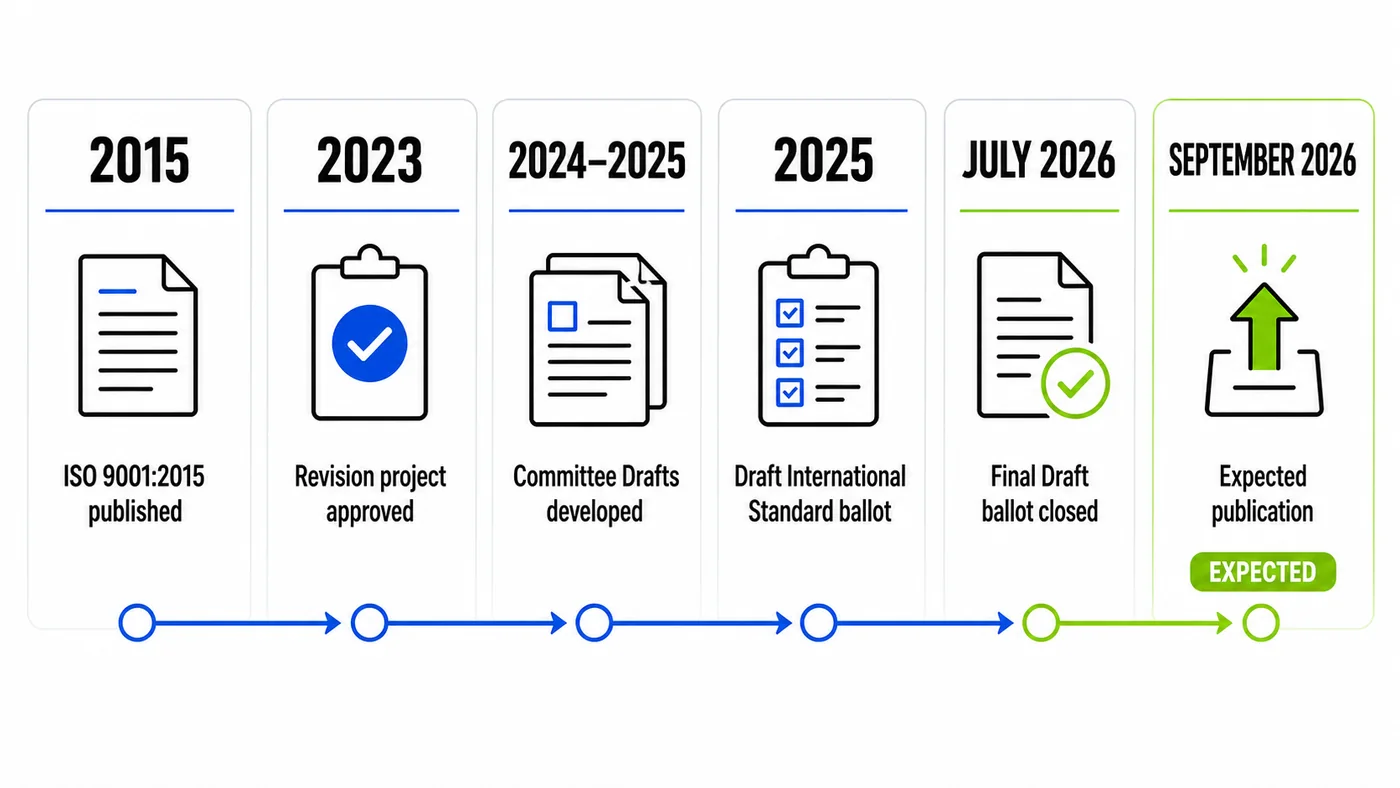
November 2023: revision project approved
ISO formally approved and registered the project to revise ISO 9001.
2024: Committee Draft development
The working group developed and consulted on a Committee Draft. Comments were reviewed, and further work was required.
January 2025: second Committee Draft consultation
A second Committee Draft was issued for consultation. The working group reviewed comments and continued developing the proposed requirements.
June 2025: progression to Draft International Standard approved
The Committee Draft was approved for registration as a Draft International Standard.
August 2025: DIS ballot opened
ISO/DIS 9001 entered the enquiry stage and was issued for voting and comment.
November 2025: DIS ballot closed
The Draft International Standard ballot closed, and the submitted comments required review and resolution.
April 2026: DIS approved for progression to FDIS
ISO recorded the Draft International Standard as approved for registration as a Final Draft International Standard.
May 2026: FDIS ballot opened
ISO/FDIS 9001 was released to ISO members for its formal approval ballot.
9 July 2026: FDIS ballot closed
The ballot on the Final Draft International Standard closed.
September 2026: expected publication
ISO currently expects the sixth edition of ISO 9001 to be published in September 2026.
Publication dates can change, so organisations should continue monitoring official information rather than planning around an assumed date that has not yet been confirmed.
What does the FDIS stage mean?
The FDIS stage means that the revision has reached the final approval part of the ISO development process.
At this stage, ISO members normally vote to approve or reject the Final Draft.
The document is considerably more mature than earlier drafts, but it is still identified as a draft until the final International Standard is published.
For organisations, this means that it is reasonable to start transition planning.
It does not mean that every procedure, form and system document should immediately be rewritten.
The most practical approach is to prepare the organisation so that it can respond efficiently once the final requirements are available.
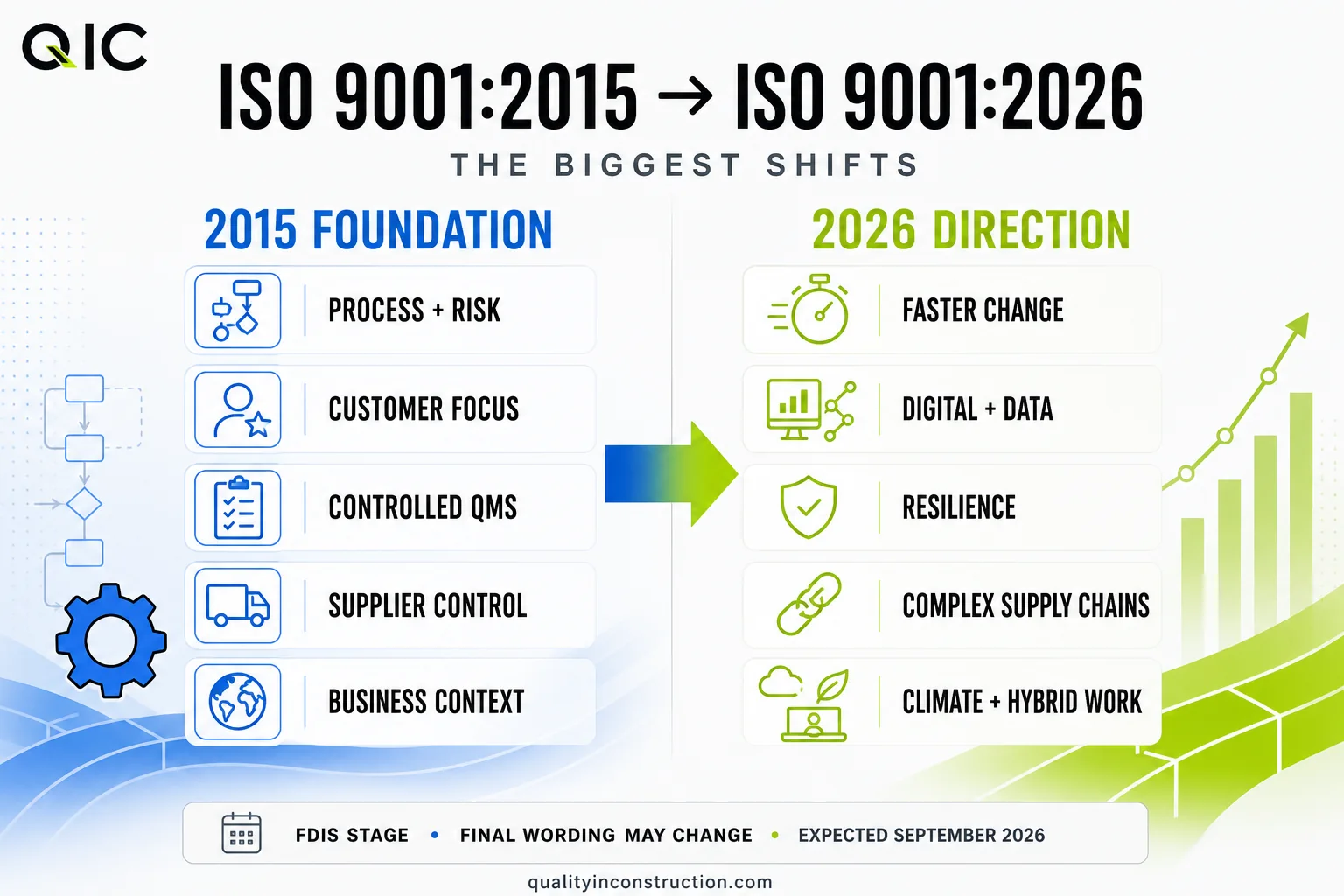
What changes will ISO 9001:2026 contain?
Detailed comparisons are already being circulated by consultants, training providers and certification organisations.
Some may be based on legitimate access to the DIS or FDIS. Others may repeat information from older drafts or present speculation as a confirmed requirement.
Without an authorised copy of ISO/FDIS 9001, it would not be responsible to provide a definitive clause-by-clause list of changes.
Even when analysing the FDIS, it is important to distinguish between:
- Completely new requirements.
- Strengthened requirements.
- Clarifications of existing requirements.
- Changes introduced by the Harmonized Structure.
- Wording changes with limited practical impact.
- Changes that could require significant action.
A separate high-level comparison article will explain the publicly confirmed areas of development without pretending to replace the Standard.
After the final edition is published, that comparison will be reviewed against the official text and expanded into a practical clause-by-clause guide.
For now, organisations should be careful about changing their systems based only on an unofficial list of “new requirements.”
Will ISO 9001:2015 certificates become invalid immediately?
No.
ISO has confirmed that organisations certified to ISO 9001:2015 will be given a transition period to move to the new edition.
However, at the time of writing, the final transition arrangements have not yet been officially published.
The transition arrangements will normally explain:
- How long certified organisations have to migrate.
- When certification bodies may begin auditing against the new edition.
- When new ISO 9001:2015 certifications must stop.
- When existing ISO 9001:2015 certificates will cease to be valid.
- How transition audits can be combined with surveillance or recertification audits.
- What certification bodies and auditors need to do.
Do not assume that the transition period will be a particular number of years simply because previous revisions used similar arrangements.
Wait for official information from ISO, accreditation organisations and your certification body.
If you are currently preparing for ISO 9001 certification, you should not automatically stop your implementation project.
A functioning ISO 9001:2015 Quality Management System will provide a much stronger foundation for transition than an incomplete system that has been waiting for the new edition.
Should organisations wait for ISO 9001:2026?
In most cases, no.
If your organisation needs ISO 9001 certification for a tender, contract, customer requirement or business objective, it should continue working against the current published Standard.
The key elements of an effective Quality Management System will not suddenly become irrelevant when the new edition is published.
Organisations will still need to:
- Understand their customers and relevant interested parties.
- Define their processes.
- Establish responsibilities.
- Provide competent people and suitable resources.
- Control operational activities.
- Manage suppliers and external providers.
- Maintain appropriate documented information.
- Monitor performance.
- Conduct internal audits.
- Hold management reviews.
- Control nonconforming outputs.
- Take corrective action.
- Improve the system.
My guide on how to implement ISO 9001 step by step can still be used to establish the main foundations of the QMS.
A weak system will not become easier to transition simply because the organisation delayed implementation.
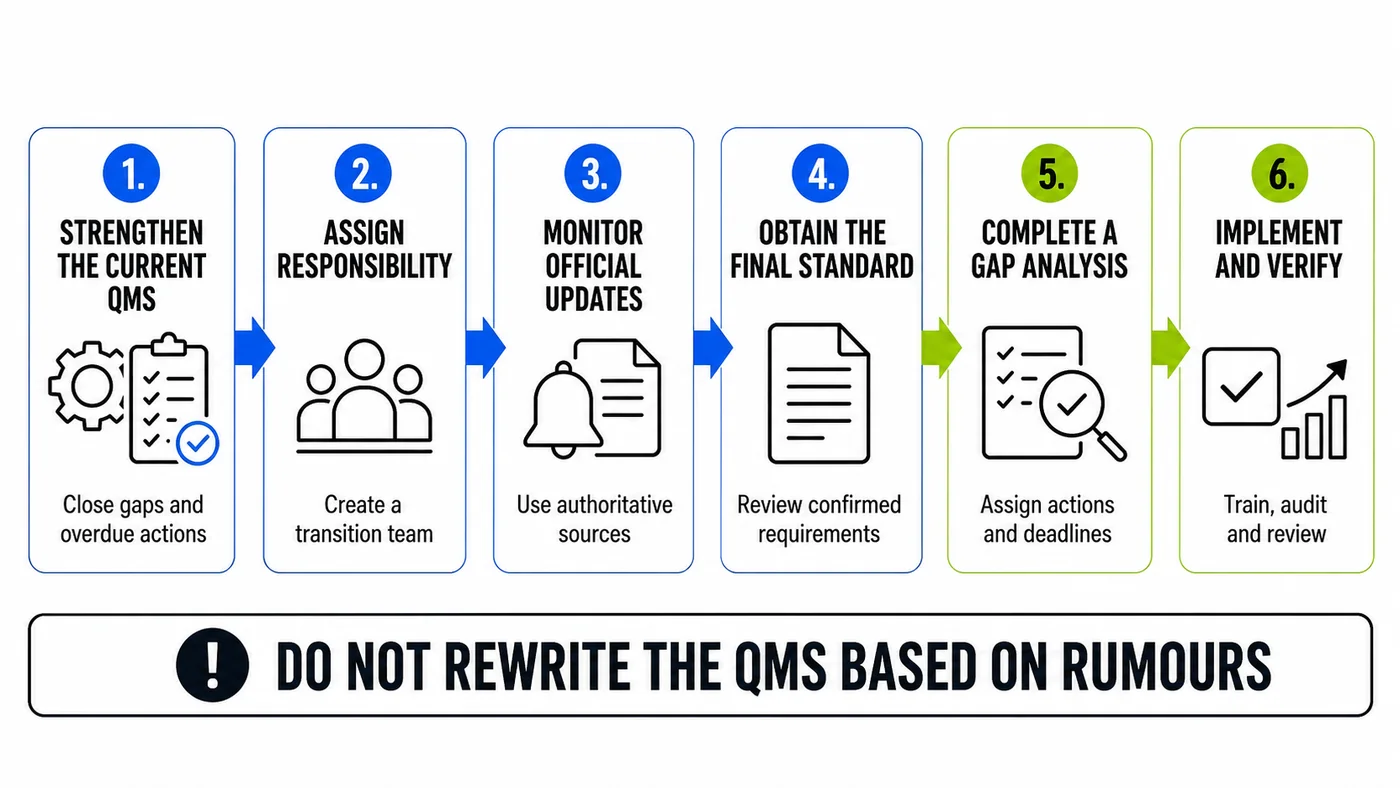
How should organisations prepare for ISO 9001:2026?
You do not need to rewrite the entire QMS now.
There are, however, several useful actions that can be taken before publication.
1. Make sure the current QMS actually works
The best preparation for the new edition is an effective system based on the current one.
This may sound obvious, but many organisations are discussing transition while carrying significant weaknesses in their existing arrangements.
Ask:
- Are processes clearly defined?
- Are responsibilities understood?
- Are quality objectives measurable?
- Are risks and opportunities addressed?
- Are suppliers properly evaluated?
- Are operational controls followed?
- Are internal audits useful?
- Does management review result in decisions?
- Are corrective actions checked for effectiveness?
- Does the documented system match what people actually do?
There is limited value in preparing a complicated transition spreadsheet if the current internal-audit programme is overdue or repeated customer complaints remain unresolved.
2. Establish responsibility for the transition
Appoint someone to coordinate the transition.
This may be the Quality Manager, HSEQ Manager, Management Systems Manager or another competent person.
However, the transition should not become their private documentation project.
Relevant process owners and top management need to be involved because changes could affect:
- Strategic planning.
- Customer management.
- Human resources.
- Procurement.
- Design.
- Production or service delivery.
- IT and information systems.
- Supplier management.
- Internal auditing.
- Performance reporting.
Create a small transition team representing the organisation’s main processes. For a small business, this may involve only two or three people.

3. Monitor official information
Use official ISO information as the main reference point.
You should also monitor communications from:
- Your national Standards body.
- The International Accreditation Forum.
- Your national accreditation body.
- Your certification body.
- Relevant professional organisations.
Training providers and consultants can provide useful explanations, but significant decisions should be checked against authoritative information.
Keep a simple revision log recording:
- The source.
- Publication date.
- Information provided.
- Possible relevance.
- Action required.
- Person responsible.
This prevents the organisation from acting on a social-media post or outdated presentation without checking the source.
4. Obtain the final Standard when it is published
Do not attempt to implement ISO 9001:2026 using only articles, webinars and comparison tables.
These can help with interpretation, but they do not replace the Standard.
Purchase an authorised copy when it becomes available and ensure that relevant people can access it.
Control it as an external document within your documented-information process.
For construction companies, this is the same basic principle as ensuring that teams use current drawings, specifications and technical Standards.
My guide to document control on construction sites explains why uncontrolled information can create significant quality, programme and commercial risks.
5. Create an inventory of the current QMS
Prepare a structured list of the processes and documented information that could be affected by the revision.
This may include:
- QMS scope.
- Quality Policy.
- Quality objectives.
- Process maps.
- Risk and opportunity registers.
- Interested-party assessments.
- Procedures.
- Work instructions.
- Forms.
- Internal-audit checklists.
- Management-review templates.
- Training material.
- Supplier requirements.
- Contract-review controls.
- Design processes.
- Inspection and testing arrangements.
- Corrective-action forms.
- Software workflows.
- External communications.
Do not revise these documents merely because they appear on the list.
The inventory will help the organisation assess the effect of confirmed changes once the final edition is available.
For construction projects, the existing quality procedures, registers, ITPs and project records should also be included where the corporate QMS affects their requirements.
6. Review process ownership
A transition is much easier when every important process has an owner.
The process owner should understand:
- What the process is expected to achieve.
- Its inputs and outputs.
- Applicable requirements.
- Responsibilities.
- Risks and opportunities.
- Controls.
- Measures.
- Records.
- Connections with other processes.
If nobody can explain who owns supplier evaluation, design review, customer complaints or corrective action, the organisation already has a problem that can be addressed now.
7. Improve risk-based thinking
Do not create another risk register simply because a revision is approaching.
Review whether risks and opportunities are actually connected to decisions and operational controls.
For example, a construction company might identify late design information as a significant risk.
The useful question is not only whether it appears in a risk register.
The organisation should determine whether the risk influences:
- Design programmes.
- Procurement decisions.
- RFI tracking and design clarification.
- Method Statement preparation.
- Inspection and Test Plans.
- Document distribution.
- Construction sequencing.
- Management reporting.
A forthcoming guide to ISO 9001 risks and opportunities will explain how to apply risk-based thinking without turning it into an unnecessary paperwork exercise.
8. Strengthen internal auditing
Internal audits can provide valuable information before the transition begins.
Use the current audit programme to determine whether processes are effective, not simply whether required documents exist.
An audit should investigate:
- How work is actually performed.
- Whether people understand their responsibilities.
- Whether controls are followed.
- Whether records provide reliable evidence.
- Whether problems are identified honestly.
- Whether previous actions have worked.
- Whether process results meet expectations.
The ISO 9001 internal audit guide and 48-question checklist provides practical questions covering Clauses 4 to 10.
Construction organisations can also use construction quality audits to examine project controls, subcontractors, inspections, document management and handover arrangements.
Once the final edition is published, the audit programme and checklists can be updated to include confirmed changes.
9. Review recurring nonconformities
Repeated problems often reveal weaknesses that will remain relevant under any edition of ISO 9001.
Review:
- Customer complaints.
- Product or service failures.
- Audit findings.
- Supplier problems.
- Missed objectives.
- Rework.
- Overdue corrective actions.
- Process failures.
- Repeated construction NCRs.
Determine whether the organisation is merely correcting individual incidents or addressing their causes.
The guide to ISO 9001 nonconformity and corrective action explains the difference between correction, root cause, corrective action and effectiveness review.
For project-specific examples, see the practical guide to the NCR process in construction.
10. Speak with your certification body
Ask your certification body how it plans to communicate the transition arrangements.
Useful questions include:
- When will transition guidance be available?
- When will auditors be trained?
- When can transition audits begin?
- Can the transition be combined with surveillance or recertification?
- Will additional audit time be required?
- What evidence will be expected?
- How will certificate expiry dates be managed?
The certification body may not have final answers before the Standard and formal arrangements are published.
That is normal.
The objective is to establish communication, not pressure the certification body into making predictions.
11. Plan resources without implementing unconfirmed changes
The organisation can reserve time and resources for:
- Purchasing the new Standard.
- Training relevant employees.
- Completing a gap analysis.
- Updating documented information.
- Changing software or digital forms.
- Communicating changes.
- Conducting internal audits.
- Holding a management review.
- Completing the certification transition.
A provisional budget and programme can be created without assuming what every change will require.
12. Avoid unnecessary rewrites
Do not use the revision as an excuse to rewrite every procedure from the beginning.
Many QMS documents may remain suitable with minor or no changes.
Focus on the effect of the confirmed requirements.
Ask:
- Does the requirement affect an existing process?
- Is a new control required?
- Does responsibility need to change?
- Is additional competence needed?
- Does existing documentation remain sufficient?
- Is new evidence required?
- Does software need to be changed?
- How will effectiveness be evaluated?
A transition should improve the system rather than simply increase the number of documents.
Practical ISO 9001:2026 preparation checklist
Before the final edition is published
- Continue using ISO 9001:2015 and Amendment 1:2024.
- Confirm that the existing QMS is properly implemented.
- Appoint a transition coordinator.
- Involve relevant process owners.
- Monitor official information.
- Create an inventory of QMS processes and documents.
- Review open audit findings.
- Review overdue corrective actions.
- Evaluate recurring customer and operational problems.
- Check whether process responsibilities are clear.
- Reserve time and resources for the transition.
- Speak with the certification body.
- Avoid rewriting documents based on rumours.
After the final edition is published
- Obtain an authorised copy.
- Review official transition guidance.
- Train the transition team.
- Complete a structured gap analysis.
- Identify affected processes and documents.
- Assign actions, owners and deadlines.
- Implement the required changes.
- Communicate changes to relevant people.
- Generate evidence that the new controls are working.
- Conduct internal audits.
- Hold a management review.
- Correct remaining gaps.
- Agree the transition audit with the certification body.
Need a practical starting point?
Use the Free ISO 9001 Starter Checklist to review the current system before the revised edition is published.
Construction example: preparing without acting too early
Consider a construction company operating several projects under an ISO 9001-certified QMS.
Its transition team could include representatives from:
- Senior management.
- Quality.
- HSEQ.
- Pre-construction.
- Design management.
- Procurement.
- Project delivery.
- Human resources.
- IT.
Before the final Standard is published, the company could review whether its existing system effectively controls:
- Tender and contract requirements.
- Design information.
- Suppliers and subcontractors.
- Approved materials.
- Method Statements.
- Inspection and Test Plans.
- Current drawings.
- Measuring equipment.
- NCRs and corrective actions.
- Handover documentation.
- Lessons learned between projects.
The company can use its existing construction Quality Management System to identify weaknesses without pretending that it has already transitioned to ISO 9001:2026.
If project teams are regularly constructing with outdated drawings, failing to complete inspections or closing NCRs without evidence, these issues should be addressed now.
They do not need to wait for a new edition of ISO 9001.
The ISO 9001 guide for construction companies explains how company-level QMS processes should connect with practical project controls.
The way those controls are monitored is also important. Inspection results, NCRs, supplier performance, audit findings, document-control data and handover readiness can all help an organisation measure quality in construction projects.
Need editable construction quality documents?
The Construction Quality Pack includes an ITP, NCR form, NCR register, corrective-action report, audit report, construction audit checklist, RFI template, Quality Policy, quality dashboard and other practical project documents.
Common mistakes to avoid during the transition
Treating unofficial summaries as the Standard
Articles and webinars can help organisations understand the revision, but they should not become the sole basis for implementation.
Waiting until the transition deadline
A last-minute transition creates unnecessary pressure and encourages superficial document changes.
Rewriting the Quality Manual before completing a gap analysis
The organisation should understand the confirmed changes and their process implications before rewriting documents.
Making the Quality Manager responsible for everything
The Quality Manager may coordinate the transition, but process owners and top management remain responsible for the areas they control.
Focusing only on documents
A procedure may be updated while employees continue following the old process.
Transition evidence needs to demonstrate implementation, not simply document approval.
Training everyone on every clause
Training should reflect the person’s role.
Top management, internal auditors, process owners and general employees will require different levels of information.
Combining the transition with too many unrelated changes
Introducing new software, restructuring responsibilities and rewriting every procedure at the same time may create confusion.
Where possible, changes should be planned and controlled in manageable stages.
How long will the ISO 9001:2026 transition take?
The official transition period has not yet been confirmed.
The amount of work required by an individual organisation will also depend on:
- Its size.
- QMS scope.
- Number of locations.
- Process complexity.
- Existing level of conformity.
- Significance of the final changes.
- Available resources.
- Certification cycle.
- Amount of documented information.
- Competence of the transition team.
A small business with a simple and effective QMS may need relatively limited changes.
A large organisation with several sites, complicated software workflows and extensive documented information may require a more structured programme.
The transition should be based on the actual effect of the new requirements, not the number of pages in the Standard.
Frequently asked questions
When will ISO 9001:2026 be published?
ISO currently expects the new edition to be published in September 2026. This remains an expected date until publication is completed.
What is ISO/FDIS 9001?
ISO/FDIS 9001 is the Final Draft International Standard. It is the late-stage draft submitted to ISO members for formal approval before publication.
Has the FDIS ballot closed?
Yes. ISO stated that the FDIS ballot would close on 9 July 2026. The new edition remains listed as under development at the time of writing.
Is ISO 9001:2015 still valid?
Yes. ISO 9001:2015, including Amendment 1:2024, remains the current published edition.
Should companies stop implementing ISO 9001:2015?
No. Organisations that need certification or want to improve their QMS should continue implementing the current Standard. A functioning ISO 9001:2015 system will provide the foundation for transition.
Will existing ISO 9001 certificates remain valid?
Existing certificates will not become invalid immediately when the new edition is published. ISO has confirmed that certified organisations will receive a transition period, but the detailed arrangements have not yet been published.
Can an organisation become certified to the FDIS?
The FDIS is not the final published International Standard. Organisations should discuss certification arrangements with an accredited certification body and continue using the current published edition until formal transition arrangements apply.
Should we update our procedures now?
Do not update procedures solely in response to rumours or unverified change summaries. Improve known weaknesses in the current QMS, create an inventory of potentially affected documents and wait for the final requirements before making transition-specific changes.
Will ISO 9001:2026 require a completely new QMS?
There is currently no reason to assume that organisations will need to replace their entire QMS. The appropriate response will depend on the confirmed changes and the organisation’s existing arrangements.
Should a company wait before applying for ISO 9001 certification?
Not necessarily. If certification is required for a contract, tender or business objective, the organisation should continue implementing ISO 9001:2015 and discuss future transition arrangements with its certification body.
Final thoughts
The ISO 9001 revision has reached its final development stage, and publication is currently expected in September 2026.
That does not mean organisations should panic or immediately rewrite their systems.
The most useful preparation is to make sure the existing Quality Management System works.
Close overdue corrective actions.
Improve weak internal audits.
Clarify process ownership.
Review risks and opportunities.
Control documents properly.
Make management reviews useful.
Address repeated customer and operational problems.
When ISO 9001:2026 is finally published, obtain the Standard, understand the confirmed changes and complete a structured gap analysis.
The objective should not be to change documents as quickly as possible.
The objective should be to use the revision as an opportunity to make the Quality Management System more practical, effective and connected to the way the organisation actually operates.
For a broader explanation of how the Standard fits together, continue with ISO 9001 Explained: A Practical Guide to Quality Management Systems.