

An RFI in construction is a Request for Information: a formal question used to obtain clarification when drawings, specifications, contract documents or other project information are incomplete, unclear or inconsistent.
A well-written construction RFI identifies the exact information that is missing, explains why it is needed, shows the possible impact and gives the designer, consultant or client enough detail to provide a clear and useful response.
RFIs are one of the most important communication tools on a construction project.
Used correctly, they prevent assumptions, reduce rework and create a traceable record of design clarifications and technical decisions.
Used badly, they become vague questions, hidden claims and overdue paperwork that delays the work.
This practical guide explains the meaning of RFI in construction, when to raise one, how the RFI process works, what an RFI form and register should include, and how to write questions that receive useful answers.
What Does RFI Stand for in Construction?
RFI stands for Request for Information. In construction, it is a controlled document used by one project party to request information or clarification from another party.
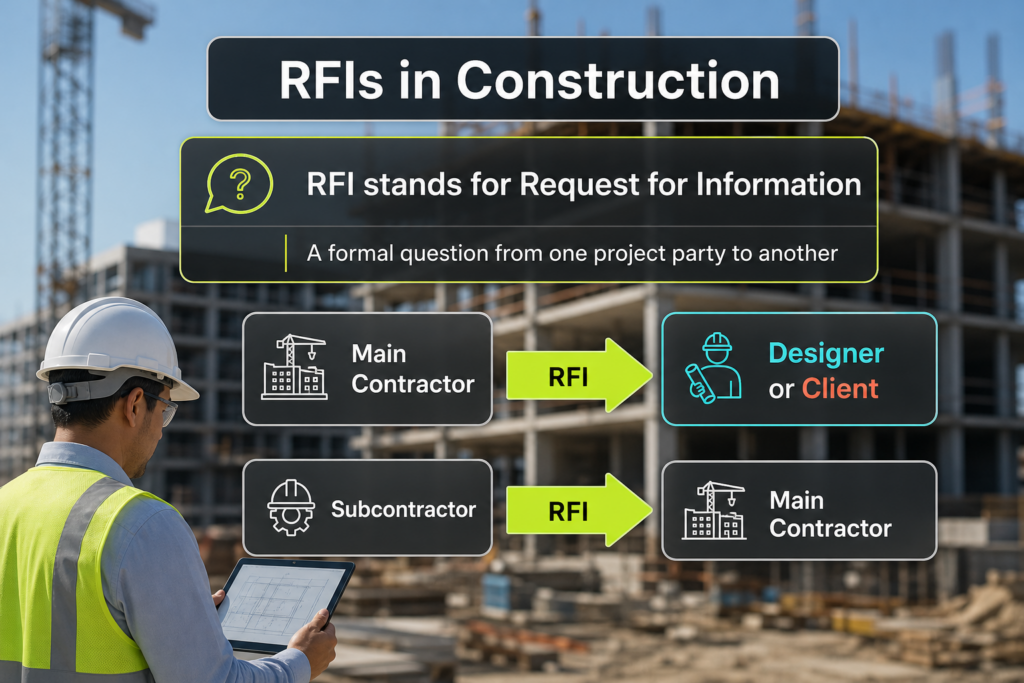
The question may relate to an unclear drawing, conflicting documents, a missing dimension, an unspecified material, an incomplete detail, a constructability problem or another technical matter that must be resolved before work can proceed correctly.
Most commonly, a contractor raises an RFI to the designer, consultant or client. However, an RFI may also be raised:
- by a subcontractor to the main contractor;
- by the main contractor to a specialist designer;
- by a supplier to the contractor;
- by a consultant to the client or another designer; or
- between different disciplines where design coordination is required.
The contract, communication procedure and project responsibility matrix should define who may raise an RFI, who is authorised to respond and how the document must be transmitted.
Does RFI Mean Request for Information or Request for Inspection?
The abbreviation RFI can cause confusion because some projects use it to mean Request for Inspection.
In this guide, RFI means Request for Information.
A Request for Information asks a technical or contractual question.
A Request for Inspection notifies the inspector that work is ready to be checked.
Many projects call the second document an Inspection Request, IR, WIR or Request for Inspection and Approval to avoid confusion.
Whatever terminology is selected, define it in the project procedures and use it consistently.
Two unrelated documents should not share the same abbreviation within the same document-control system.
Why RFIs Are Important in Construction
Construction projects involve a large volume of drawings, specifications, schedules, models, material submissions and instructions.
These documents are prepared by different people and disciplines, often under significant programme pressure. Gaps and inconsistencies are therefore inevitable.
Without a formal RFI process, site teams may make assumptions, rely on informal conversations or continue with work that later has to be changed.
A controlled RFI process helps to:
- resolve missing, unclear or conflicting project information;
- prevent work from proceeding on an unsupported assumption;
- provide a traceable record of questions, answers and decisions;
- identify possible effects on programme, cost, quality or safety;
- make technical information visible to the relevant project parties;
- support drawing revisions and as-built information;
- reduce disputes about what was asked, answered or instructed; and
- capture recurring design and coordination problems for improvement.
An RFI does not transfer responsibility automatically.
It records a question and the authorised response.
Design responsibility, contractual entitlement and liability continue to depend on the contract and the facts of the issue.
When Should an RFI Be Raised?
Raise an RFI when the information required to plan, procure, construct, inspect or complete the work cannot be established clearly from the approved project documents.
Typical reasons include:
- a missing dimension, level, detail or specification;
- conflicting information between drawings;
- a drawing that conflicts with the specification or schedule;
- an unclear material, finish, tolerance or performance requirement;
- a design detail that cannot be constructed as shown;
- an interface problem between architectural, structural and MEP work;
- a discrepancy between the existing site condition and the design;
- missing information needed for procurement or fabrication;
- an unclear response in a previous instruction or submittal review;
- a proposed technical alternative that needs a formal decision; or
- information required to complete an inspection, test or handover record.
Raise the RFI early enough for the response to be reviewed and incorporated into the work.
An RFI issued the day before an activity starts is not good planning when the information gap was visible weeks earlier.
When Should an RFI Not Be Used?
An RFI is primarily a request for missing or unclear information.
It should not be used as a substitute for every other project process.
Unless the contract says otherwise, do not use an RFI:
- to request information that is already clearly available in the approved documents;
- to report nonconforming work that requires an NCR;
- as a formal variation, change order or compensation-event submission;
- as a substitute for a material or technical submittal;
- to submit shop drawings for approval;
- to issue a contractual notice, delay claim or early warning;
- to request an inspection of completed work;
- to issue an instruction to the contractor;
- to avoid reviewing the drawings, specification or contract; or
- to redesign work that remains the contractor’s responsibility.
The correct process depends on the contract. Some projects use technical queries, field change requests, design change notices or clarification requests instead of, or alongside, RFIs.
The Construction RFI Process
A practical RFI workflow should be simple enough to use consistently and controlled enough to maintain traceability.
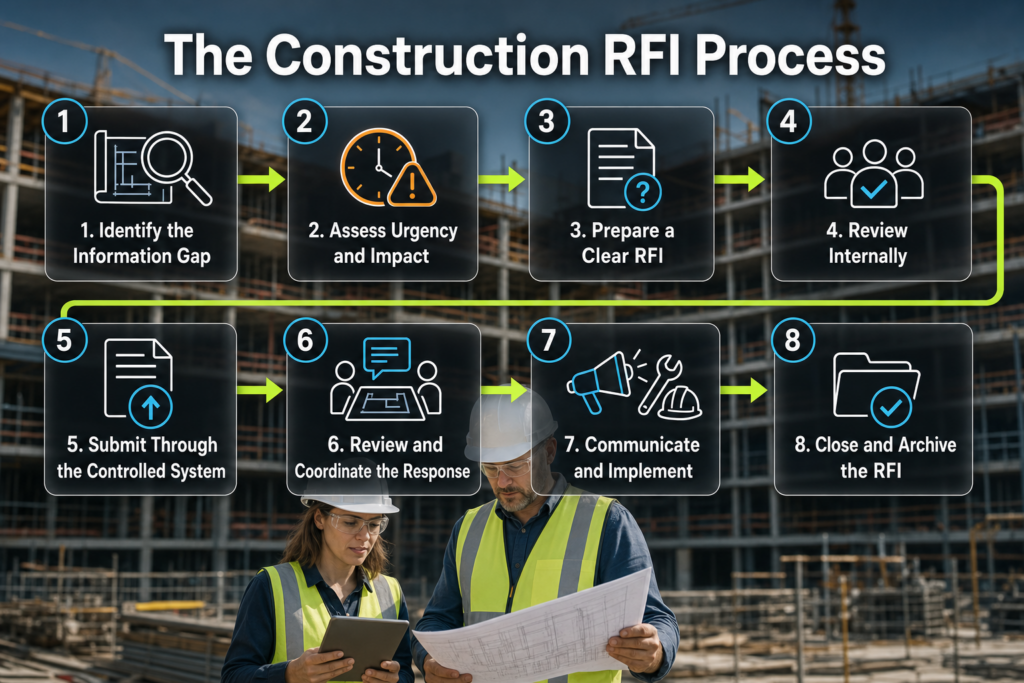
1. Identify the information gap
The person discovering the issue should review the relevant drawings, specifications, models, schedules, approved submittals and previous RFIs. Confirm that the answer is not already available.
This initial review prevents unnecessary questions and helps define the exact conflict or omission.
2. Assess urgency and potential impact
Determine when the response is genuinely required and whether the issue affects procurement, fabrication, planned inspections, a hold point, access, sequence, cost or the critical path.
If work could become unsafe or nonconforming, stop or protect the affected activity while the issue is resolved. Do not continue based on an unsupported assumption merely because an RFI has been raised.
3. Prepare a clear RFI
Describe one issue, identify the precise location and reference the relevant documents and revisions. Explain what is unclear and ask a direct question.
Include marked-up drawings, photographs, sketches, model views or other evidence where they make the issue easier to understand.
4. Review the RFI internally
Before formal submission, the contractor’s engineer, design manager or other authorised reviewer should check that:
- the answer is not already in the contract documents;
- the question is clear and within the recipient’s responsibility;
- the document references and revisions are correct;
- the proposed solution does not unintentionally transfer design responsibility;
- commercial or programme implications are identified appropriately; and
- only one main issue is included.
5. Submit through the document control system
Issue the RFI formally through the agreed Electronic Document Management System (EDMS), common data environment or document-control process.
The system should allocate a unique number, record the date and route the question to the authorised respondent.
Avoid managing RFIs through personal email chains. Email may support notification, but the controlled RFI and response should remain visible, searchable and traceable in the project system.
6. Review and coordinate the response
The recipient may need input from the architect, engineer, client, specialist designer or other disciplines. The response should answer the question directly and identify any revised documents, conditions or further actions.
If the response changes the design, scope, cost or programme, follow the applicable change-control and contractual processes. An RFI response should not be allowed to become an uncontrolled design change.
7. Communicate and implement the answer
The answer must reach the people who need it: supervisors, subcontractors, procurement teams, inspectors, planners and document controllers. Update affected work packs, shop drawings, method statements and Inspection and Test Plans where required.
A response that remains inside the document-management system but never reaches the site team has not solved the problem.
8. Close and archive the RFI
Close the RFI only when the response is clear, accepted through the required process and communicated to the relevant parties. Link it to revised drawings, instructions, submittals, change records or NCRs where applicable.
Important RFIs should be captured in As-built records and handover documentation (red-line drawings etc) when they clarify or alter the final constructed condition.
How to Write a Good Construction RFI
A good RFI should allow someone who is not standing beside the author to understand the problem quickly and answer it without a second round of questions.
Use a specific title
Avoid titles such as “Slab question” or “More information required.” Use the location and issue:
Level 03, Grid B4–B6: Conflict between structural beam depth and mechanical duct route
Reference exact documents and revisions
Identify drawing numbers, details, specification sections, model references and revisions. If two documents conflict, reference both and describe the difference.
Describe facts rather than opinions
State what the documents show and what is missing or inconsistent. Avoid blame, assumptions and unnecessary background.
Ask one clear question
The recipient should be able to identify exactly what decision or clarification is required. Multiple unrelated questions should normally be separated into different RFIs so that they can be routed and closed independently.
Include a proposed solution carefully
A proposed solution can speed up the response, particularly when the contractor has specialist knowledge or has reviewed constructability. Make clear that it is a proposal requiring the appropriate review. Do not present it as approved or use it to bypass formal design responsibility.
State the required-by date and impact
Use a realistic date linked to the programme, procurement or work sequence. If no response by that date may affect the work, explain the potential impact factually without turning the technical question into a disguised claim.
What Should a Construction RFI Form Include?
An effective RFI template should contain enough information to make the question and response traceable from submission to implementation.
- Project name and contract number
- Unique RFI number
- Date raised and date submitted
- Originator and organisation
- Recipient and responsible discipline
- RFI title and subject
- Location, level, grid, asset or work package
- Drawing, specification, model and document references with revisions
- Clear description of the issue
- Specific question requiring an answer
- Proposed solution, if applicable
- Attachments, photographs, sketches and marked-up drawings
- Potential quality, safety, programme or cost impact
- Required response date
- Formal response
- Respondent’s name, role and date
- References to revised drawings, instructions or change records
- Distribution and implementation actions
- Status and closure date
Keep the form practical. The objective is to receive and implement reliable information, not to create paperwork for its own sake.
Use an editable RFI form instead of starting from scratch. Get the RFI Template →
The Construction Quality Pack includes the RFI template and 11 additional editable quality documents for inspections, NCRs, audits, corrective actions, reporting and project records.
Construction RFI Examples
Example 1: Conflict between structural and mechanical drawings
Situation: The structural drawing shows a 700 mm deep beam at Level 03. The coordinated mechanical drawing shows a duct passing through the same zone, but no opening or alternative route is detailed.
Weak RFI: “Please advise how to install the duct.”
Better RFI: “Structural drawing S-301 Rev C shows a 700 mm deep beam between Grids B4 and B6. Mechanical drawing M-214 Rev B shows duct D-17 passing through the same zone. No approved beam penetration is shown. Please confirm whether the duct route should be revised or provide an approved structural opening detail. A response is required by 18 July to avoid affecting Level 03 duct fabrication.”
Example 2: Missing architectural dimension
Situation: A partition is shown in plan, but its position cannot be established from the available dimensions.
Better RFI: “Architectural drawing A-142 Rev D shows partition P-07 in Room 3.18 but does not provide its offset from Gridline 5 or the adjacent structural column. Please provide the setting-out dimension required to install the partition. See attached marked-up drawing.”
Example 3: Specification and drawing conflict
Situation: The door schedule specifies one fire rating while the specification states another.
Better RFI: “Door schedule A-601 Rev F identifies Door D-204 as FD60. Specification Section 08 11 00, clause 2.4, identifies doors to the same enclosure as FD90. Please confirm the required fire rating for Door D-204 and advise whether the door schedule will be revised.”
Example 4: Existing site condition differs from the design
Situation: Excavation reveals an existing service that is not shown in the available survey information.
Better RFI: “An unidentified 150 mm service has been exposed at Grid C7, approximately 450 mm below the proposed foundation level shown on drawing C-220 Rev B. Work in the affected area has been protected. Please confirm the service status and provide instructions regarding diversion, protection or revision of the foundation detail. Photographs and survey coordinates are attached.”
Bad RFI vs Good RFI
| Bad RFI | Good RFI |
|---|---|
| Uses a vague title | Identifies the location, element and issue |
| Asks a broad or ambiguous question | Requests one specific decision or clarification |
| Does not reference documents | Lists exact drawing and specification revisions |
| Includes several unrelated issues | Deals with one coordinated subject |
| Provides no evidence | Includes marked-up drawings, photographs or sketches |
| Demands an immediate response without explanation | Provides a justified required-by date and factual impact |
| Uses blame or argumentative language | Describes the technical facts professionally |
| Asks for information already available | Shows that the relevant documents were reviewed |
RFI Register and Status Tracking
An RFI register provides the project team with a single view of all questions, responsibilities, deadlines and responses. It can be maintained in a spreadsheet for a small project or generated by the project’s EDMS or common data environment.
At a minimum, the register should show:
- RFI number and title;
- date raised and submitted;
- originator and recipient;
- discipline and location;
- required response date;
- actual response date;
- current status;
- days open or overdue;
- programme or procurement impact;
- linked drawings, instructions or change records; and
- closure and distribution status.
Useful status categories include Draft, Under Internal Review, Submitted, Under Review, Response Received, Further Information Required, Closed and Cancelled. Define the categories so that everyone interprets them consistently.
RFI Response Times and Overdue RFIs
There is no universal RFI response period. The required time may be stated in the contract, communication procedure or agreed project workflow. Common targets might be seven, ten or fourteen days, but the appropriate period depends on the complexity and urgency of the question.
Do not mark every RFI as urgent. Priority should reflect actual risk to safety, quality, procurement, access, sequence or programme.
Monitor:
- average response time;
- RFIs answered within the agreed period;
- open and overdue RFIs;
- RFIs approaching their required-by date;
- RFIs requiring multiple response cycles;
- RFIs affecting procurement or critical activities; and
- responses received but not yet communicated or implemented.
Review critical RFIs at coordination and progress meetings. Escalate overdue questions through the contractual communication route before the delay becomes irreversible.
RFI vs NCR, Submittal, Site Instruction and Change Request
| Document | Main purpose | Typical use |
|---|---|---|
| RFI | Request missing or unclear information | Clarify a drawing conflict or missing design detail |
| NCR | Control a failure to meet a requirement | Record and close nonconforming work or material |
| Submittal | Submit information for review or approval | Materials, shop drawings, method statements or technical data |
| Site instruction | Issue an authorised direction | Direct the contractor to take a defined action |
| Change request | Propose and assess a formal change | Change scope, design, cost or programme |
| Request for inspection | Notify that work is ready for inspection | Request inspection at an ITP stage or hold point |
| Technical query | Request technical clarification | Often similar to an RFI, depending on project terminology |
Documents can be related. For example, an NCR in construction may require an RFI to obtain a technical disposition. An RFI response may identify the need for a formal design change. The related records should be cross-referenced, but one document should not be used to bypass another required process.
Common RFI Mistakes
Raising an RFI without checking the documents
Unnecessary RFIs waste time and damage confidence in the process. Review the relevant drawings, specifications, schedules, models, submittals and previous responses first.
Submitting vague questions
“Please provide more information” does not identify the missing information or the decision needed. State the exact issue, location and question.
Including multiple unrelated questions
Different disciplines may need to answer different subjects. Combining them makes routing, response and closure difficult.
Raising RFIs too late
Monitor upcoming work, procurement and approvals so information gaps are identified before they affect the programme.
Treating the RFI as a claim
Keep the RFI focused on the technical question. Submit notices, variations and claims through the processes defined by the contract.
Accepting an ambiguous response
A response such as “proceed as required” may not resolve the technical issue. Seek clarification before construction continues if the requirement remains unclear.
Failing to distribute the response
The site team, subcontractor, inspector and procurement staff may all need the answer. Closing the RFI in the system is not enough.
Failing to update the design documents
When numerous RFIs clarify the same drawing, revise and reissue the drawing. Construction should not depend indefinitely on a collection of separate responses.
How to Reduce Unnecessary RFIs
A high number of RFIs is not automatically evidence of poor performance, because project size and complexity vary. However, repeated avoidable RFIs may indicate weaknesses in design coordination, document quality or preconstruction review.
Reduce unnecessary RFIs by:
- conducting coordinated design reviews before construction;
- using constructability and buildability reviews;
- reviewing models for interdisciplinary clashes;
- maintaining current and accessible project documents;
- briefing teams on the specification and communication procedures;
- reviewing previous RFIs before raising new ones;
- using clear responsibility matrices;
- tracking recurring RFI subjects and root causes; and
- revising documents when repeated clarifications show that they are no longer adequate.
Frequently Asked Questions
What does RFI mean in construction?
RFI means Request for Information. It is a formal question used to obtain clarification about missing, unclear or conflicting construction information.
What is the full form of RFI in construction?
The full form is Request for Information. Some projects also use RFI for Request for Inspection, so the project document-control procedure should define the intended meaning.
Who raises an RFI in construction?
A contractor, subcontractor, supplier, consultant or other authorised project party may raise an RFI. Most contractor RFIs are directed to the consultant, designer or client through the agreed communication process.
Who answers an RFI?
The person or organisation with authority and responsibility for the requested information should answer. This may be the architect, engineer, consultant, client, specialist designer or main contractor.
Is an RFI a change order?
No. An RFI requests information. Its response may reveal or create the need for a change, but that change should be assessed and authorised through the contract’s formal change-control process.
Can an RFI be used as an instruction?
Normally, an RFI is a question rather than an instruction. The response may contain or lead to an authorised direction, depending on the contract and the respondent’s authority.
How long should an RFI take to answer?
The response period should follow the contract or project procedure. The time required depends on complexity and urgency. The required-by date should be linked to the actual programme or procurement need.
What is an RFI log?
An RFI log or register is the controlled list of RFIs showing their numbers, subjects, dates, responsible parties, response deadlines, status and closure information.
Should RFIs be managed by email?
Email may be used for notifications, but the formal question and response should be managed through the project’s controlled document-management system so they remain visible, searchable and traceable.
Final Thoughts
RFIs are essential because construction teams should not be expected to build from missing, conflicting or unclear information. A good RFI process gives the project a controlled way to ask questions, coordinate decisions and communicate reliable answers.
The quality of the response often depends on the quality of the question. Reference the correct documents, explain the exact issue, ask one direct question and provide enough evidence for the recipient to understand the problem quickly.
Most importantly, make sure the response reaches the people doing, supervising and inspecting the work. An answered RFI only creates value when the information is correctly implemented and reflected in the project records.