
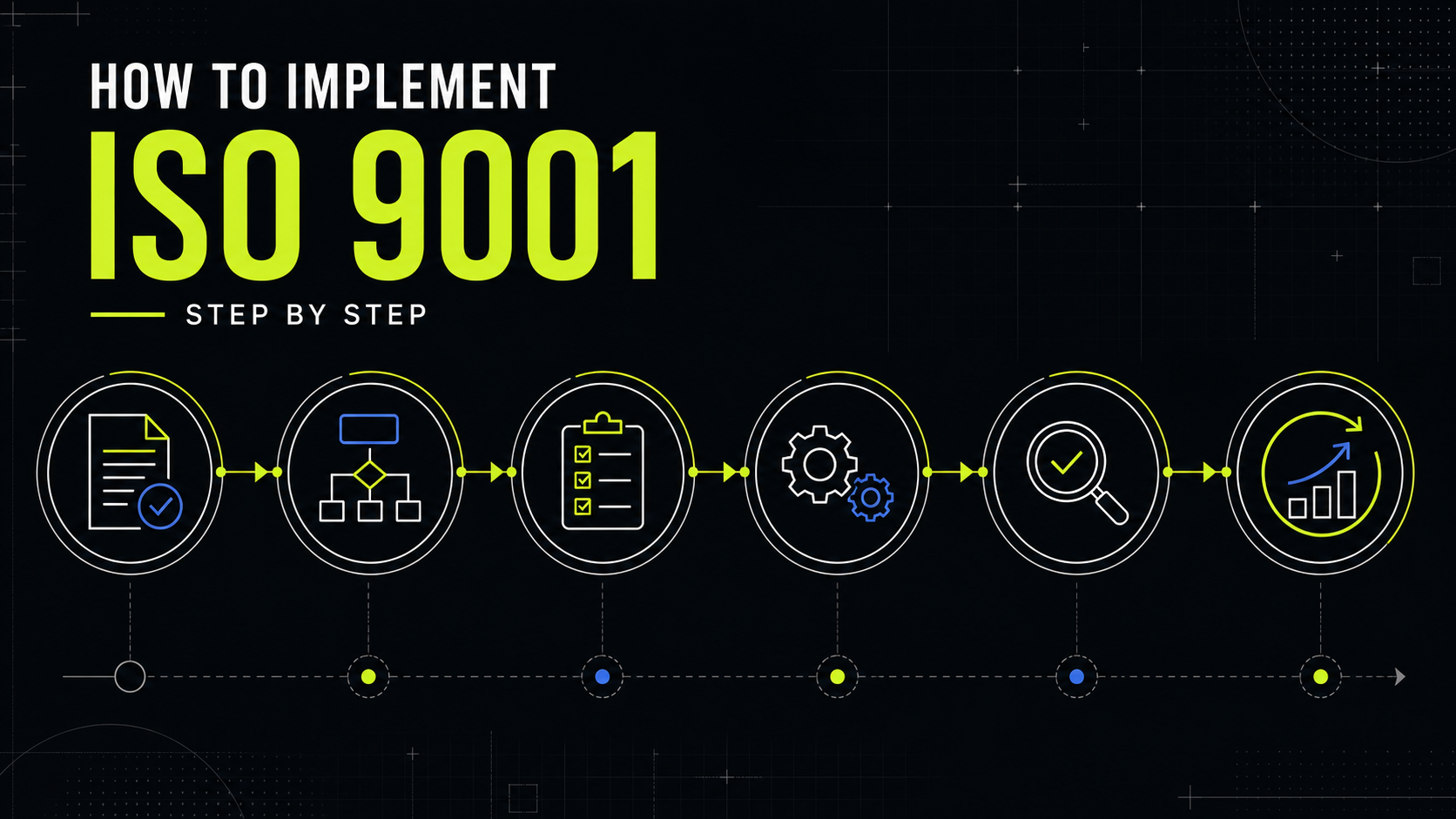
Implementing ISO 9001 can feel like a large project when you first read the Standard.
The requirements cover leadership, planning, resources, operations, audits, performance evaluation and continual improvement.
However, implementation becomes much more manageable when it is treated as a series of practical steps.
You do not need to create a complicated collection of procedures before anyone can start working. You need to understand how the organisation currently operates, identify what ISO 9001 requires and build a Quality Management System around the processes people actually use.
This guide explains how to implement ISO 9001 step by step, from the initial decision through to certification and continual improvement.
Revision update: ISO 9001:2015 remains the current published edition. A revised edition is expected in September 2026. Organisations implementing ISO 9001 now should continue using ISO 9001:2015 and monitor official transition information.
What does ISO 9001 implementation involve?
ISO 9001 implementation involves establishing, operating and improving a Quality Management System that meets the requirements of the Standard.
This normally includes:
- Understanding the organisation and its customers.
- Defining the scope of the Quality Management System.
- Identifying the organisation’s processes.
- Assigning responsibilities and authorities.
- Managing risks and opportunities.
- Establishing quality objectives.
- Controlling operational activities.
- Maintaining appropriate documented information.
- Monitoring performance and customer satisfaction.
- Conducting internal audits.
- Holding management reviews.
- Correcting problems and improving the system.
ISO 9001 tells organisations what their Quality Management System needs to achieve. It does not prescribe one fixed way of operating.
That flexibility is important.
A small specialist contractor does not need the same system as an international manufacturer. The processes, risks, records and level of documentation should reflect the size and complexity of the organisation.
Contractors can find more industry-specific guidance on building an ISO 9001 Quality Management System for construction projects.
Before you begin: decide why you are implementing ISO 9001
Before creating procedures or registers, establish why the organisation wants to implement ISO 9001.
The reason may be:
- A customer or tender requirement.
- Access to new markets.
- Improved control over operations.
- Fewer defects, complaints or repeated problems.
- More consistent ways of working.
- Better management information.
- Preparation for independent certification.
- Integration with another management system.
This decision affects the project.
If certification is required for a tender, there may be a fixed deadline. If the objective is operational improvement, the organisation may have more flexibility but will still need a clear implementation plan.
The reason should also be understood by top management. A Quality Management System is unlikely to work if it is treated only as a project for the quality manager.
Step 1: Obtain and understand the ISO 9001 requirements
The first step is to obtain an authorised copy of ISO 9001 and understand how its requirements apply to the organisation.
The auditable requirements are contained in Clauses 4 to 10:
- Clause 4: Context of the organisation.
- Clause 5: Leadership.
- Clause 6: Planning.
- Clause 7: Support.
- Clause 8: Operation.
- Clause 9: Performance evaluation.
- Clause 10: Improvement.
Do not begin by turning every sentence into a separate procedure.
Start by understanding the purpose of each clause and how the requirements connect with existing business activities.
For example:
- Customer requirements may already be reviewed when quotations or contracts are prepared.
- Supplier performance may already be monitored by the purchasing team.
- Competence may already be managed through recruitment, training and supervision.
- Product or service conformity may already be checked through inspections, testing or reviews.
- Problems may already be recorded through complaints, defect reports or nonconformity reports.
The objective is to strengthen and connect these activities, not automatically replace them.
My guide to ISO 9001 requirements should be used alongside this implementation roadmap to understand Clauses 4 to 10 in more detail.
Step 2: Secure leadership commitment
Top management must support the implementation and remain involved in the Quality Management System.
This involves more than approving the project or paying a consultant.
Management should:
- Establish why the system is needed.
- Connect quality objectives with business priorities.
- Provide suitable people, time and resources.
- Define responsibilities and authorities.
- Promote customer focus.
- Review QMS performance.
- Support corrective action and improvement.
- Demonstrate that quality is part of normal management.
ISO 9001 does not require the appointment of a quality manager. However, someone normally needs to coordinate implementation.
This person may organise the gap analysis, maintain the implementation plan, arrange meetings and audits, and help process owners understand the requirements.
Responsibility for the effectiveness of the QMS still remains with top management.
Step 3: Define the implementation team and responsibilities
ISO 9001 should not be implemented by one person working alone.
Select people who understand the main parts of the organisation. Depending on its structure, the implementation team could include representatives from:
- Senior management.
- Operations.
- Sales or contract management.
- Purchasing.
- Human resources.
- Design or technical departments.
- Production or service delivery.
- Quality.
- Customer service.
- Finance or administration.
The team does not need to be large. In a small business, several responsibilities may belong to the same person.
Assign an owner to each important process. A process owner should understand how the process works, what it should achieve, what could go wrong and how its performance is monitored.
Create a simple implementation plan showing:
- The activity.
- The responsible person.
- The target date.
- The current status.
- Any required resources.
- The evidence needed to demonstrate completion.
This plan should be reviewed regularly throughout implementation.
Step 4: Define the context and interested parties
Clause 4 requires the organisation to understand the internal and external issues that can affect its Quality Management System.
These issues may include:
- Customer expectations.
- Legal and regulatory requirements.
- Market conditions.
- Technology.
- Availability of competent people.
- Supplier capacity.
- Organisational structure.
- Business strategy.
- Existing systems and company culture.
- Environmental or operational conditions.
The organisation must also identify relevant interested parties and their relevant requirements.
Interested parties might include:
- Customers.
- Employees.
- Regulators.
- Owners or shareholders.
- Suppliers.
- Certification bodies.
- Industry authorities.
- Insurers.
- Business partners.
This exercise should be practical. A long list of every person or organisation that could possibly have an interest will not necessarily help manage quality.
Focus on the parties and issues that can affect the organisation’s ability to provide conforming products and services consistently.
Record the results in a format that can be reviewed. This could be a context register, business plan, SWOT analysis or management review record.
Step 5: Define the scope of the Quality Management System
The QMS scope defines the organisational boundaries and activities covered by the system.
It should consider:
- The organisation’s locations.
- Its products and services.
- Relevant internal and external issues.
- Relevant interested-party requirements.
- Any ISO 9001 requirements that are not applicable.
The scope should be clear and accurate.
For example:
The provision of design, manufacture, installation and maintenance services for commercial ventilation systems from the organisation’s London facility.
Avoid a scope that is so vague that customers cannot understand what the certification covers.
An ISO 9001 requirement can only be treated as not applicable when its exclusion does not affect the organisation’s ability or responsibility to provide conforming products and services and improve customer satisfaction.
Design and development is a common example. It may not apply where the organisation works entirely to designs provided and controlled by its customer. However, it should not be excluded merely because the organisation calls its design activity something different.
Step 6: Identify and map your processes
ISO 9001 uses a process approach.
A process takes inputs, performs activities and produces outputs. Processes also interact with one another.
Typical QMS processes include:
- Enquiry and contract review.
- Design and development.
- Purchasing.
- Supplier management.
- Production or service delivery.
- Inspection and testing.
- Control of nonconforming outputs.
- Training and competence management.
- Document control.
- Internal auditing.
- Management review.
- Corrective action.
Create a high-level process map showing how work moves through the organisation.
For each important process, establish:
- The purpose of the process.
- Its inputs and outputs.
- The sequence of activities.
- The process owner.
- Required resources.
- Responsibilities and authorities.
- Applicable controls.
- Risks and opportunities.
- Performance measures.
- Records or other documented information.
- Connections with other processes.
Do not create a complicated process map simply to impress an auditor. It should help people understand how the business operates.
Step 7: Conduct an ISO 9001 gap analysis
A gap analysis compares current arrangements with the requirements of ISO 9001.
Review every applicable requirement and determine whether it is:
- Fully addressed.
- Partially addressed.
- Not addressed.
- Not applicable.
For each gap, record:
- The relevant ISO 9001 clause.
- What already exists.
- What is missing or ineffective.
- The action required.
- The responsible person.
- The target completion date.
- The evidence of completion.
A gap analysis should examine implementation as well as documentation.
A procedure may exist but not be followed. Conversely, an effective process may be operating without adequate evidence or consistent control.
Interview employees, observe activities and review records. Do not rely only on the contents of a shared folder.
The completed gap analysis becomes the foundation of the implementation plan.
Step 8: Address risks and opportunities
ISO 9001 requires the organisation to determine and address risks and opportunities that could affect the intended results of the QMS.
This does not necessarily require a formal enterprise risk-management system.
A proportionate approach may include:
- Discussing risks during process reviews.
- Maintaining a risk and opportunity register.
- Including controls within procedures or process maps.
- Reviewing project, contract or operational risks.
- Monitoring actions through management meetings.
Examples of quality-related risks include:
- Unclear customer requirements.
- Inadequate design reviews.
- Supplier failure.
- Use of obsolete documents.
- Insufficient competence.
- Equipment breakdown.
- Missed inspections.
- Incorrect product identification.
- Incomplete records.
- Repeated complaints.
Possible responses include eliminating the risk, reducing its likelihood, reducing its effect, sharing it or accepting it with appropriate monitoring.
Opportunities should also be considered. These may include automation, improved training, new suppliers, simplified processes or better use of performance data.
Actions should be proportionate to the potential effect on product and service conformity.
Step 9: Establish the quality policy and objectives
The quality policy provides the overall direction of the QMS.
It should:
- Be appropriate to the organisation.
- Support its strategic direction.
- Provide a framework for setting quality objectives.
- Include commitments to meet applicable requirements.
- Include a commitment to continual improvement.
The policy should be communicated and understood. Employees do not necessarily need to recite it word for word, but they should understand what it means for their work.
Quality objectives turn the policy into measurable priorities.
Examples include:
- Reduce customer complaints by 20% within 12 months.
- Achieve at least 95% on-time delivery each quarter.
- Close corrective actions within 30 days.
- Maintain supplier acceptance above 98%.
- Complete planned internal audits within the annual programme.
- Reduce rework costs to below 2% of sales.
Each objective should have:
- A measure.
- A baseline where possible.
- A target.
- A responsible owner.
- A timescale.
- A method of review.
- Any resources or actions required.
Avoid objectives such as “improve quality” unless the organisation defines how improvement will be measured.
Step 10: Define roles, competence and awareness
People who affect quality must be competent based on appropriate education, training or experience.
Begin by identifying the competence required for relevant roles.
Evidence might include:
- Qualifications.
- Licences.
- Training records.
- Experience.
- Practical assessments.
- Supervised work.
- Performance reviews.
- Authorisation records.
Attendance at a training course does not automatically demonstrate competence. The organisation should evaluate whether the person can apply what they learned.
Employees should also understand:
- The quality policy.
- Relevant quality objectives.
- How their work contributes to the QMS.
- The consequences of not following requirements.
- The importance of reporting problems.
This is often best achieved through induction, workplace coaching, briefings and normal management—not just a single ISO 9001 presentation.
Step 11: Create the documented information you actually need
ISO 9001 does not require a quality manual or a separate written procedure for every clause.
The organisation must maintain the documented information specifically required by the Standard and whatever else is necessary for effective process control.
Useful QMS documents may include:
- The QMS scope.
- Quality policy.
- Quality objectives.
- Process maps.
- Procedures.
- Work instructions.
- Specifications.
- Inspection plans.
- Forms and templates.
- Approved supplier lists.
- Registers.
- Checklists.
Required evidence may include:
- Contract reviews.
- Design reviews.
- Inspection and test results.
- Calibration records.
- Training and competence records.
- Supplier evaluations.
- Internal audit reports.
- Management review records.
- Nonconformity and corrective-action records.
Create documentation where it helps people work consistently, control significant risks or retain necessary evidence.
Do not document a process in unnecessary detail when competent employees can perform it effectively using a simpler control.
Step 12: Establish document and record control
Documents must be available where they are needed and protected from unintended use or alteration.
The document-control process should address:
- Document identification.
- Review and approval.
- Version or revision status.
- Access and distribution.
- Changes.
- Storage and protection.
- Retention.
- Disposal.
- External documents such as standards, drawings or customer specifications.
Employees should be able to identify the current approved version.
Records require similar control, although they normally provide evidence of completed activities and should not be revised in the same way as working documents.
A document register can help, but it is not the only solution. Modern document-management platforms can control approval, permissions, revision history and access without a separate manual register.
Step 13: Implement operational controls
Clause 8 covers the activities used to provide products and services.
The exact controls will depend on the organisation, but they may include:
- Reviewing customer requirements before accepting work.
- Controlling changes to orders or contracts.
- Planning design and development.
- Selecting and monitoring suppliers.
- Providing clear purchasing information.
- Controlling production or service delivery.
- Identifying and tracing outputs where required.
- Protecting customer property.
- Preserving products during handling and storage.
- Conducting inspections, tests or reviews.
- Authorising release.
- Controlling nonconforming outputs.
The controls should reflect the risks involved.
A high-risk, safety-critical or regulated activity will normally require more planning, verification and documented evidence than a simple low-risk service.
This is the stage where the QMS must move from documents into daily work.
Brief employees, introduce the approved controls and begin collecting real records. Monitor whether the process is practical and adjust it when legitimate problems are identified.
Step 14: Control external providers
Organisations remain responsible for products, processes and services supplied externally.
Supplier control should begin before an order is placed and continue throughout the relationship.
Establish:
- Supplier-selection criteria.
- Approval methods.
- Purchasing requirements.
- Required qualifications or certifications.
- Inspection or verification arrangements.
- Performance measures.
- Re-evaluation methods.
- Actions for poor performance.
Not every supplier requires the same level of control.
A supplier providing a critical component should normally receive more attention than a supplier providing low-risk office materials.
Possible performance measures include:
- Delivery performance.
- Defect rate.
- Responsiveness.
- Documentation accuracy.
- Complaint history.
- Corrective-action performance.
- Commercial reliability.
Keep evidence of supplier evaluation, selection, monitoring and re-evaluation.
Step 15: Manage nonconforming outputs and corrective action
Despite effective planning, problems will still occur.
The organisation must identify and control outputs that do not meet requirements. Depending on the situation, it may:
- Correct the problem.
- Segregate or contain the affected output.
- Suspend delivery or use.
- Inform the customer.
- Obtain formal acceptance or concession.
- Scrap or replace the output.
- Verify the corrected work again.
Not every isolated error requires a full root-cause investigation. However, significant, repeated or systemic problems should lead to corrective action.
Corrective action should consider:
- What happened?
- What immediate action was taken?
- What caused the problem?
- Could the same cause affect other products, services or processes?
- What action will prevent recurrence?
- Who is responsible?
- When will the action be completed?
- How will its effectiveness be verified?
Closing a corrective action because a new procedure was issued is not enough. The organisation should confirm that the action actually addressed the cause.
Step 16: Monitor performance and customer satisfaction
The organisation needs evidence that its processes and QMS are working.
Possible performance measures include:
- Customer complaints.
- Customer satisfaction.
- On-time delivery.
- Product or service defects.
- Rework.
- Scrap.
- Process cycle time.
- Supplier performance.
- Audit findings.
- Corrective-action closure.
- Achievement of quality objectives.
Select measures that help management make decisions. Collecting large quantities of data that nobody reviews adds little value.
ISO 9001 also requires the organisation to monitor customers’ perceptions of whether their requirements have been met.
This might use:
- Customer surveys.
- Feedback forms.
- Complaints.
- Repeat business.
- Contract reviews.
- Online reviews.
- Account-management meetings.
- Customer scorecards.
- Warranty or return data.
Customer satisfaction does not have to depend on one annual questionnaire.
Step 17: Conduct internal audits
Internal audits assess whether the QMS:
- Meets the organisation’s own arrangements.
- Meets the applicable ISO 9001 requirements.
- Is effectively implemented and maintained.
Create an audit programme that considers:
- The importance of each process.
- Changes affecting the organisation.
- Previous audit results.
- Process performance.
- Known risks or repeated problems.
Auditors should be objective and impartial. They should not normally audit work for which they are directly responsible.
A useful audit examines actual implementation. It follows activities, samples records, interviews employees and looks at how processes connect.
Before certification, all applicable parts of the QMS should be covered by the internal audit programme.
Findings should be recorded, communicated and addressed without unnecessary delay.
Step 18: Hold a management review
Top management must review the QMS at planned intervals.
The review should consider subjects such as:
- Previous management-review actions.
- Changes in internal and external issues.
- Customer satisfaction.
- Quality objectives.
- Process performance.
- Product and service conformity.
- Nonconformities and corrective actions.
- Monitoring and measurement results.
- Audit results.
- Supplier performance.
- Resource adequacy.
- Risks and opportunities.
- Improvement opportunities.
The outputs should include decisions and actions relating to:
- QMS improvement.
- Process, product or service improvement.
- Resource requirements.
- Necessary changes to the system.
The meeting should result in decisions, not simply the presentation of data.
Before certification, the organisation should complete at least one genuine management review using real performance information from the implemented system.
Step 19: Correct the remaining gaps
After internal audits and management review, some weaknesses will probably remain.
This is normal.
Review:
- Outstanding gap-analysis actions.
- Internal audit findings.
- Overdue corrective actions.
- Missing records.
- Objectives without adequate monitoring.
- Processes that employees do not understand.
- Documents that do not match actual practice.
- Management-review actions.
- Supplier or customer issues.
Correct the underlying problems and verify the effectiveness of important actions.
Do not rush into certification while the system exists mainly on paper. The organisation needs enough operating evidence to demonstrate that its processes have been implemented.
Step 20: Select a certification body
Certification is not a mandatory requirement of ISO 9001, but many organisations pursue it to provide independent assurance to customers.
When selecting a certification body, consider:
- Accreditation.
- Recognition in relevant markets.
- Industry experience.
- Auditor competence.
- Geographic coverage.
- Audit-day requirements.
- Certification and surveillance costs.
- Availability.
- Customer-service arrangements.
ISO develops and publishes ISO 9001. It does not certify organisations.
The certification audit is performed by a certification body. An accreditation body provides independent recognition of the certification body’s competence.
Obtain several quotations and confirm exactly what is included.
Step 21: Complete the Stage 1 audit
The initial certification audit is normally completed in two stages.
Stage 1 is primarily a readiness review.
The auditor may examine:
- The QMS scope.
- Key documented information.
- Organisational context.
- Processes and locations.
- Applicable legal or regulatory requirements.
- Internal audit arrangements.
- Management review.
- Readiness for Stage 2.
The auditor will identify areas that could prevent successful completion of Stage 2.
Treat Stage 1 as a useful assessment of readiness—not as a rehearsal where incomplete implementation can be hidden.
Address the findings before the Stage 2 audit.
Step 22: Complete the Stage 2 audit
Stage 2 evaluates the implementation and effectiveness of the QMS.
The auditor will normally:
- Speak with managers and employees.
- Observe activities.
- Review records.
- Sample completed work.
- Follow processes across departments.
- Evaluate operational controls.
- Examine performance information.
- Review internal audits and management review.
- Assess how nonconformities and corrective actions are managed.
The audit is based on sampling. The auditor does not inspect every record or activity.
Any nonconformities must be addressed in accordance with the certification body’s requirements. Depending on their significance, evidence of correction and corrective action may be reviewed remotely or through a follow-up visit.
Certification can be issued after the certification body completes its independent review and confirms that the applicable requirements have been met.
Step 23: Maintain and improve the QMS
Certification is not the end of implementation.
The organisation must continue to:
- Monitor processes and objectives.
- Review customer feedback.
- Control documents and records.
- Evaluate suppliers.
- Maintain competence.
- Conduct internal audits.
- Hold management reviews.
- Address nonconformities.
- Manage change.
- Identify improvement opportunities.
Certification bodies normally perform surveillance audits during the certification cycle, followed by recertification.
A QMS can become ineffective when documentation is maintained only for audits. The strongest systems are used to manage the organisation throughout the year.
How long does ISO 9001 implementation take?
There is no standard implementation period.
A small organisation with established processes may be ready within a few months. A large, multi-site or poorly controlled organisation may require considerably longer.
The timescale depends on:
- Organisational size.
- Number of locations.
- Process complexity.
- Existing management controls.
- Availability of competent people.
- Leadership involvement.
- Amount of documentation required.
- Number and significance of identified gaps.
- Certification-body availability.
A realistic implementation programme might take between four and twelve months, but this should not be treated as a guaranteed range.
The important question is not how quickly documents can be produced. It is how long the organisation needs to implement the system, generate evidence and confirm that it works.
What documents are required for ISO 9001?
There is no universal ISO 9001 document pack that suits every organisation.
The documented information should support the organisation’s processes, risks, people and products or services.
At a minimum, ensure that the organisation has the documented information explicitly required by ISO 9001 and the evidence needed to demonstrate effective implementation.
Common documents and records include:
- QMS scope.
- Quality policy.
- Quality objectives.
- Process information.
- Competence records.
- Operational records.
- Design and development records, where applicable.
- Supplier evaluation records.
- Inspection, testing and release records.
- Calibration or verification records.
- Nonconformity records.
- Internal audit results.
- Management review results.
- Corrective-action records.
The quantity of documentation is less important than whether it is accurate, controlled and useful.
Common ISO 9001 implementation mistakes
Writing the system before understanding the business
Generic procedures often fail because they do not reflect actual responsibilities, systems or risks.
Map the real processes first.
Treating implementation as the quality manager’s job
The quality manager may coordinate the project, but process owners and top management must remain responsible for their activities.
Creating too much documentation
More documents do not automatically provide more control. Excessive documentation can make the QMS difficult to use and maintain.
Copying a generic ISO 9001 template pack
Templates can provide a useful starting point, but every document should be adapted to the organisation.
Focusing only on passing the audit
A system designed only for certification may produce a certificate without delivering meaningful operational improvement.
Leaving internal audits until the end
Internal audits help identify weak implementation. They should not be treated as a last-minute formality.
Recording risks without taking action
A risk register has limited value if actions, controls and responsibilities are not established.
Confusing correction with corrective action
Correcting a defective output deals with the immediate issue. Corrective action addresses the cause to reduce the chance of recurrence.
Setting objectives that cannot be measured
Objectives need defined measures, owners, targets and review arrangements.
Failing to retain evidence
An activity may have been completed correctly, but the organisation may still need suitable evidence that it occurred.
A simple ISO 9001 implementation checklist
Before arranging certification, confirm that the organisation has:
- Obtained and reviewed the current Standard.
- Secured leadership commitment.
- Defined implementation responsibilities.
- Identified internal and external issues.
- Identified relevant interested parties.
- Established the QMS scope.
- Identified and mapped its processes.
- Completed a gap analysis.
- Addressed risks and opportunities.
- Approved a quality policy.
- Established measurable quality objectives.
- Defined roles and responsibilities.
- Determined competence requirements.
- Implemented document and record controls.
- Established appropriate operational controls.
- Implemented supplier controls.
- Controlled nonconforming outputs.
- Established corrective-action arrangements.
- Monitored process performance.
- Evaluated customer satisfaction.
- Completed internal audits.
- Held a management review.
- Corrected significant gaps.
- Generated sufficient evidence of implementation.
- Selected an accredited certification body where certification is required.
Final thoughts
ISO 9001 implementation should not begin with the question, “Which procedures do we need to write?”
A better question is:
How do we ensure that our processes consistently deliver what our customers require, and how can we demonstrate that those processes are controlled and improving?
Begin with the organisation’s real activities. Understand the requirements, involve the people responsible for the processes and introduce controls that match the risks involved.
Documentation should support the system rather than become the system.
When implemented properly, ISO 9001 provides more than preparation for a certification audit. It creates a practical framework for controlling work, measuring performance, resolving problems and improving how the organisation operates.