
Revision update: ISO 9001:2015 remains the current published edition. A revised edition is expected in September 2026. This guide is based on the current requirements and will be updated when the new edition is published.
ISO 9001 is the most widely recognised Quality Management System Standard in the world.
However, it is also one of the most misunderstood.
Some people see ISO 9001 as a collection of procedures that nobody reads. Others think it is simply a certificate that a company needs to tender for larger projects.
And in some organizations, the Quality Management System is treated like a separate administrative exercise managed by the Quality Department.
None of these approaches represents what ISO 9001 is actually trying to achieve.
When implemented properly, ISO 9001 provides a practical framework for running a business consistently, meeting customer requirements, controlling risks and learning from problems.
It does not tell a company exactly how to operate. Instead, it establishes the requirements that the organization needs to address through processes that are appropriate for its size, activities, risks and customers.
In this guide, I will explain what ISO 9001 means, how a Quality Management System works and what organizations need to do to implement the Standard in practice.
ISO 9001 revision update: ISO 9001:2015 remains the current published edition. A revised edition is expected to be published in September 2026. This article is based on the current requirements and will be updated when the new edition is officially published.
What is ISO 9001?
ISO 9001 is an international Standard that specifies requirements for a Quality Management System, commonly called a QMS.
The Standard can be used by any type of organization that wants to demonstrate its ability to provide products and services that consistently meet customer, statutory and regulatory requirements.
This could include:
- Construction companies
- Engineering consultancies
- Manufacturers
- Professional service providers
- Technology businesses
- Government departments
- Healthcare providers
- Training organizations
- Subcontractors and suppliers
- Small family businesses
- Large multinational companies
ISO 9001 is not limited to a particular industry, country or size of business.
A small specialist subcontractor can use the same Standard as an international contractor. Their Quality Management Systems will obviously look very different, but they are both working towards the same basic objective: delivering consistent results and improving customer satisfaction.
The current edition is ISO 9001:2015, including the 2024 climate action amendment. ISO is developing its replacement, which is expected in September 2026.
What is a Quality Management System?
A Quality Management System is the collection of processes, responsibilities, controls, documents and records an organization uses to deliver its products or services.
In simple terms, it is how the organization makes sure that work is planned, completed, checked and improved.
Every established business already has some form of management system, even if nobody calls it a QMS.
For example, a construction company will probably already have processes for:
- Reviewing tenders and contracts
- Managing design information
- Selecting subcontractors and suppliers
- Purchasing materials
- Preparing Method Statements
- Producing Inspection and Test Plans
- Inspecting completed work
- Controlling drawings and specifications
- Managing Nonconformances
- Handing the completed project over to the Client
The purpose of ISO 9001 is not necessarily to replace these processes.
The first objective should be to understand how the company already operates, identify the gaps and establish enough control to make the system reliable.
This is an important point because far too many organizations try to build their QMS around the wording of the Standard.
They create a procedure for every clause, fill folders with forms and then expect employees to change the way they work just to satisfy the new system.
The result is usually a collection of documents that looks impressive during an audit but has very little connection to what actually happens in the office, factory or construction site.
A good Quality Management System should reflect the real business.
If the system only works during an ISO audit, then it does not really work.
What does ISO 9001 help a business achieve?
The main purpose of ISO 9001 is to help an organization consistently provide products and services that meet requirements.
That sounds simple, but it covers almost every important part of a business.
A properly implemented QMS can help an organization:
- Understand what its customers expect
- Define responsibilities more clearly
- Control operational processes
- Reduce mistakes and repeated problems
- Manage suppliers and subcontractors
- Maintain competent personnel
- Keep documents and records under control
- Monitor performance
- Investigate failures
- Improve customer satisfaction
- Make decisions using reliable information
In construction, this could mean making sure that the correct drawing is available before work begins, the specified material has been approved, the inspection is carried out at the correct stage and the completed record is included in the handover file.
If any part of that process fails, the consequences could include defective work, delays, additional cost, rejected handover documentation or a dispute with the Client.
ISO 9001 provides the framework for controlling those activities.
It cannot guarantee that mistakes will never happen. No management system can do that.
What it can do is reduce the likelihood of failures, identify problems earlier and make sure the organization learns when something goes wrong.
Does ISO 9001 guarantee quality?
No.
An ISO 9001 certificate does not guarantee that every product, service or construction project will be perfect.
The certificate shows that the organization has been assessed against the requirements of ISO 9001 and has established a Quality Management System within the stated scope.
It does not mean that individual products have been certified.
It also does not remove the need for technical inspections, testing, supervision, competent personnel or compliance with applicable specifications.
For example, an ISO 9001-certified contractor must still inspect its work and demonstrate that the completed construction meets the drawings, specifications and contractual requirements.
The certificate does not replace an Inspection and Test Plan, a material approval, a concrete test result or an as-built record.
This is why the practical implementation of the QMS is far more important than the certificate hanging on the office wall.
The seven quality management principles
ISO 9001 is based on seven quality management principles.
These principles help explain the thinking behind the requirements of the Standard.
1. Customer focus
An organization needs to understand its customers, meet their requirements and aim to improve customer satisfaction.
In construction, the immediate customer may be the Client or principal contractor. However, the organization may also need to consider end users, authorities, designers and other interested parties.
Customer focus does not mean agreeing to every request regardless of the contract.
It means understanding the agreed requirements, communicating clearly and delivering what has been promised.
2. Leadership
Senior management needs to take responsibility for the effectiveness of the Quality Management System.
Quality cannot be delegated entirely to a Quality Manager.
The Quality Department can develop procedures, organize audits, analyse performance and support the operational teams. But it cannot create a quality culture without the involvement of senior management.
If a Project Director tells the team to ignore an inspection because the programme is under pressure, the message is clear: quality requirements only matter when they are convenient.
No Quality Policy or toolbox talk can compensate for that kind of leadership.

3. Engagement of people
People at every level affect the quality of the final product or service.
Employees need to understand their responsibilities, be competent to perform their work and feel able to report problems.
A strong quality culture is not one where no NCRs are reported.
It is one where problems are identified honestly, controlled properly and used as opportunities to improve.
4. Process approach
The process approach means managing activities as connected processes rather than isolated departments or tasks.
Every process has inputs, activities and outputs.
For example, a material approval process might begin with the project specification and supplier information. It could then include technical review, sample approval and Client acceptance. The output is an approved material that can be purchased and installed.
That output then becomes an input to purchasing, delivery inspection, storage and installation.
Understanding these connections is important because a failure in one process often creates problems somewhere else.

5. Improvement
Organizations should continually look for opportunities to improve their performance.
Improvement does not always require a major project or expensive software.
It might involve revising an unclear form, changing an approval workflow, providing additional training or removing an unnecessary step that delays the work.
The important thing is that improvement is based on evidence and actually makes the process more effective.
6. Evidence-based decision-making
Important decisions should be based on reliable information rather than assumptions.
Useful information can come from:
- Audit findings
- NCR data
- Customer feedback
- Inspection results
- Supplier performance
- Process measurements
- Complaints
- Rework costs
- Programme delays
- Lessons learned
For example, simply counting the number of NCRs on a project does not provide enough information.
The organization may also need to analyse their causes, severity, cost, responsible processes and whether similar problems are being repeated.
7. Relationship management
Organizations depend on suppliers, subcontractors and other external parties.
These relationships need to be managed carefully because external providers can directly affect the quality of the final product or service.
In construction, a large proportion of the work may be completed by subcontractors. A contractor can have excellent internal procedures and still fail if its subcontractors, designers and suppliers are not properly selected, controlled and monitored.
ISO 9001 requirements explained
The main auditable requirements of ISO 9001 are contained in Clauses 4 to 10.
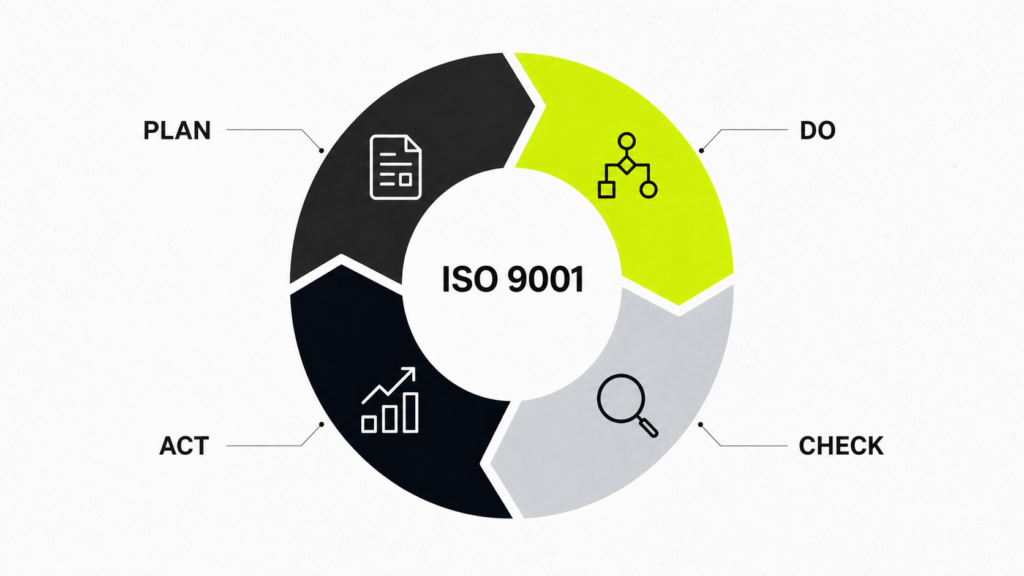
These clauses follow a logical structure that can be connected to the Plan-Do-Check-Act cycle.
Clause 4: Context of the organization
Clause 4 is about understanding the organization and establishing the boundaries of the Quality Management System.
The organization needs to consider:
- Internal and external issues that could affect the QMS
- Relevant interested parties and their requirements
- The scope of the Quality Management System
- The processes needed for the system
This is where an organization defines what its QMS covers and how its main processes interact.
For a construction company, relevant issues could include market conditions, labour availability, new legislation, Client requirements, supply-chain capacity and the use of digital project information.
The organization must also determine whether climate change is a relevant issue and consider whether interested parties have climate-related requirements. This requirement was introduced through ISO 9001:2015 Amendment 1:2024.
Clause 5: Leadership
Clause 5 places responsibility for the QMS with top management.
Senior leaders need to demonstrate commitment, promote customer focus, establish the Quality Policy and assign appropriate responsibilities.
This does not mean that the Managing Director must write every procedure.
It means that senior management should make sure the QMS supports the direction of the business, has the resources it needs and achieves its intended results.
The Quality Policy should not be a generic statement downloaded from the internet and displayed in reception.
It should explain the organization’s commitment to quality, provide a framework for its objectives and be relevant to what the business actually does.
Clause 6: Planning
Clause 6 covers risks, opportunities, quality objectives and the planning of changes.
The organization needs to consider what could prevent its QMS from achieving the intended results and what opportunities could improve performance.
ISO 9001 does not require every organization to use a complicated risk-scoring system.
The method should be proportionate to the business.
A construction project might manage risk through tender reviews, design risk registers, procurement schedules, Method Statements, ITPs, programme reviews and project risk workshops.
The organization must also establish measurable quality objectives and plan how they will be achieved.
Examples could include:
- Reducing repeated NCRs
- Improving on-time document approvals
- Increasing Client satisfaction
- Reducing rework costs
- Closing corrective actions within agreed timescales
- Improving supplier performance
Clause 7: Support
Clause 7 covers the resources needed to operate the Quality Management System.
This includes:
- People
- Infrastructure
- Working environment
- Monitoring and measuring resources
- Organizational knowledge
- Competence
- Awareness
- Communication
- Documented information
This clause is where organizations need to make sure people are competent, suitable resources are available and documents are controlled.
Document control is especially important in construction.
If an outdated drawing reaches the site, the result may be incorrect work, wasted materials and expensive rework. A document-control process is therefore not just an administrative requirement. It is an operational control.
Clause 8: Operation
Clause 8 is where the organization plans and controls the work needed to provide its products and services.
Depending on the organization, this can include:
- Reviewing customer requirements
- Design and development
- Purchasing
- Supplier and subcontractor control
- Production or service delivery
- Identification and traceability
- Preservation
- Inspection and release
- Control of nonconforming outputs
For a contractor, Clause 8 reaches right into the practical management of the project.
It affects how requirements are reviewed, how design is controlled, how materials are approved, how subcontractors are managed, how inspections are carried out and how defective work is prevented from being accepted.
Clause 9: Performance evaluation
Clause 9 requires the organization to check whether the QMS is working.
This includes:
- Monitoring and measurement
- Analysis and evaluation
- Customer satisfaction
- Internal audits
- Management review
Internal audits should not be treated as exercises in asking employees whether they know where to find the Quality Policy.
A useful audit follows a process, checks objective evidence and identifies whether controls are effective.
Management review should also be more than an annual meeting held shortly before the certification audit.
It is an opportunity for senior management to review performance, consider changes, examine problems and agree actions for improvement.
Clause 10: Improvement
Clause 10 deals with nonconformity, corrective action and continual improvement.
When something goes wrong, the organization needs to:
- Control and correct the problem
- Deal with its consequences
- Investigate the cause where appropriate
- Decide whether similar problems could exist elsewhere
- Implement corrective action
- Check whether the action was effective
- Update the QMS if necessary
Correction and corrective action are not the same thing.
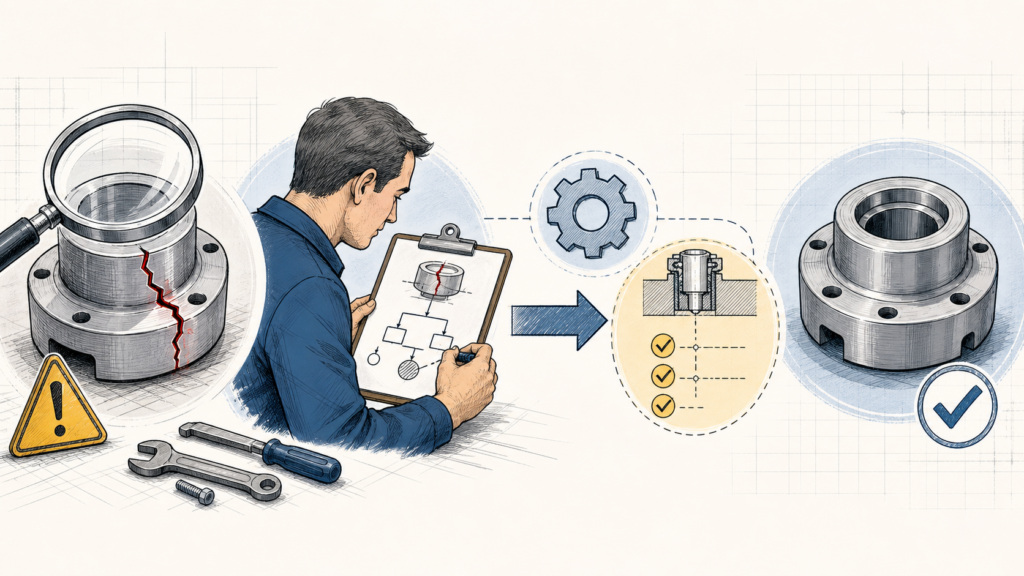
If incorrectly installed work is removed and replaced, that is a correction.
If the organization investigates why the wrong work was installed and changes the process to prevent it from happening again, that is corrective action.
This distinction is extremely important. Repairing the immediate problem without addressing its cause means the same failure may return on the next floor, the next project or with the next subcontractor.
What documents does ISO 9001 require?
One of the most common misconceptions about ISO 9001 is that it requires a large Quality Manual and a procedure for every clause.
It does not.
ISO 9001 uses the term “documented information” and allows organizations flexibility in deciding how much documentation they need.
The level of documentation will depend on factors such as:
- The organization’s size
- The complexity of its processes
- The competence of its people
- The risks involved
- Customer and contractual requirements
- Statutory and regulatory obligations
Typical QMS documents and records may include:
- Quality Policy
- Quality objectives
- QMS scope
- Process maps
- Procedures
- Work instructions
- Forms and templates
- Training and competence records
- Supplier evaluations
- Inspection records
- Calibration records
- Audit reports
- Management-review records
- NCRs and corrective actions
- Customer feedback
- Performance reports
A construction project may also use a Project Quality Plan, Method Statements, ITPs, checksheets, material approvals, RFIs, drawing registers and handover records.
The objective is not to create the largest possible collection of documents.
The objective is to maintain the documented information needed to operate the processes effectively and provide evidence that requirements have been met.
Is ISO 9001 certification mandatory?
ISO 9001 certification is normally voluntary.
An organization can implement the requirements of ISO 9001 without becoming certified.
However, certification may be required by a Client, contract, framework agreement, regulator or tender process.
This is especially common in construction, engineering, manufacturing and other industries where customers need confidence that suppliers have controlled management systems.
Certification is performed by an independent certification body.
The certification body audits the organization’s QMS and, if the applicable requirements have been met, issues a certificate covering a defined scope and locations.
The process usually includes:
- Selecting a certification body
- Submitting information about the organization and its scope
- Completing a Stage 1 audit
- Addressing any issues identified
- Completing a Stage 2 certification audit
- Correcting any nonconformities
- Receiving certification
- Completing regular surveillance audits
- Completing recertification before the certification cycle ends
It is also worth checking whether the certification body is accredited by a recognised national accreditation body.
How long does ISO 9001 implementation take?
There is no single answer.
The implementation period depends on:
- The size of the organization
- The number of sites
- The complexity of its processes
- Existing management controls
- Available resources
- Employee involvement
- The readiness of records
- The intended certification scope
A small organization with clear existing processes may be able to implement a QMS within a few months.
A larger company operating across several offices, projects or countries may require considerably longer.
The biggest mistake is trying to write all the documents first and understand the business afterwards.
A more practical implementation sequence is:
- Define the scope
- Understand the organization and its interested parties
- Identify the main processes
- Review existing controls
- Complete a gap analysis
- Assign responsibilities
- Develop or improve the necessary documentation
- Implement the processes
- Train the relevant people
- Collect records
- Carry out internal audits
- Complete a management review
- Correct any identified gaps
- Proceed with certification, if required
The system needs time to operate before certification. An auditor will not only check what the procedures say. They will also look for evidence that the processes have been implemented.
Common ISO 9001 mistakes
Organizations can pass a certification audit and still have a QMS that provides very little value.
Some of the most common mistakes include:
- Copying generic procedures that do not reflect the business
- Making the Quality Manager responsible for everything
- Creating too many forms
- Collecting data without analysing it
- Treating internal audits as checklists only
- Closing NCRs without investigating their causes
- Setting objectives that cannot be measured
- Failing to control outsourced processes
- Keeping the QMS separate from operational management
- Preparing for ISO audits only a few weeks before they happen
The QMS should be part of the normal operation of the business.
Tender reviews, project meetings, design reviews, supplier evaluations, inspections and performance reports may already satisfy parts of the Standard if they are properly controlled.
There is no benefit in creating a second system purely for ISO 9001.
How to get started with ISO 9001
Start with the business, not the paperwork.
Identify what the organization provides, who its customers are and which processes affect the quality of its products or services.
Then ask some simple questions:
- What requirements must we meet?
- Who is responsible for each process?
- What could go wrong?
- What controls are already in place?
- What information do people need?
- What evidence should be retained?
- How do we know whether the process is working?
- What happens when something goes wrong?
- How do we improve?
The answers will give you the foundations of the Quality Management System.
From there, you can compare the existing system with Clauses 4 to 10, identify any gaps and decide what needs to be improved.
Do not begin by writing dozens of procedures.
A process map, a clear responsibility matrix and a realistic gap analysis are usually far more useful at the beginning.
ISO 9001:2015 and the forthcoming 2026 edition
ISO 9001:2015 is still the current published edition of the Standard.
At the time of writing, the replacement has reached the Final Draft International Standard stage and is expected to be published in September 2026.
Organizations should therefore continue to implement, maintain and audit their systems against ISO 9001:2015 and its applicable amendment.
There is no reason to delay worthwhile improvements while waiting for the new edition.
A QMS with clear processes, active leadership, useful performance data, effective corrective action and sensible risk management will provide a strong starting point for any future transition.
Once the new edition is officially published, certified organizations will be given a transition period. The detailed arrangements should be confirmed through official ISO, accreditation and certification-body communications.
Until then, be careful with websites, consultants or training providers claiming that unverified draft changes are already mandatory.
Final thoughts
ISO 9001 should not be about generating paperwork for an auditor.
It should help an organization understand its processes, control its risks, meet customer requirements and improve the way it operates.
In construction, that means connecting the Quality Management System with what actually happens during tendering, design, procurement, construction, inspection and handover.
A QMS becomes valuable when people use it to make better decisions and prevent real problems.
The certificate may help the company win work.
But the system behind the certificate is what protects the Client, the project and the business.
Frequently asked questions
What does ISO stand for?
ISO is the International Organization for Standardization, an independent international organization that develops standards through its members.
“ISO” is the organization’s universal short name rather than an English-language acronym.
What is the latest version of ISO 9001?
ISO 9001:2015 is the current published edition. A revised edition is expected to be published in September 2026.
What is the difference between ISO 9001 and a QMS?
ISO 9001 is a Standard containing requirements for a Quality Management System. The QMS is the actual system an organization establishes and operates.
Can a small business use ISO 9001?
Yes. ISO 9001 can be applied to organizations of any size. A small business should develop a proportionate system rather than copying the documentation of a much larger company.
Does ISO 9001 require a Quality Manual?
ISO 9001:2015 does not specifically require a Quality Manual. An organization can still maintain one if it is useful for explaining the scope, processes and structure of the QMS.
Does ISO 9001 require a Quality Manager?
No specific job title is required. The organization must assign relevant responsibilities and authorities, while top management remains accountable for the effectiveness of the QMS.
Can individuals become ISO 9001 certified?
No. ISO 9001 certification applies to an organization’s management system. Individuals can complete auditor or lead-auditor training, but they are not personally certified to ISO 9001.
Is ISO 9001 only about quality control?
No. Quality control activities such as inspections and testing form only part of the system. ISO 9001 also covers leadership, planning, resources, competence, customer requirements, suppliers, performance evaluation and improvement.
Is ISO 9001 certification permanent?
No. Certified organizations are normally subject to surveillance audits and periodic recertification. Certification can be suspended or withdrawn if the organization fails to maintain conformity.
Should we wait for ISO 9001:2026 before implementing a QMS?
No. ISO 9001:2015 remains the current published edition. Building a practical and effective QMS now will put the organization in a stronger position when the revised Standard and formal transition arrangements are published.