
Many organisations operate separate systems for quality, environmental management and health and safety.
They have one policy for quality, another policy for the environment and another one for health and safety.
They carry out separate audits, organise separate management review meetings and maintain several procedures covering almost exactly the same process.
The result is usually an unnecessary pile of documents, repeated work and a management system that becomes more complicated than the organisation itself.
An Integrated Management System, commonly called an IMS, provides a more practical alternative.
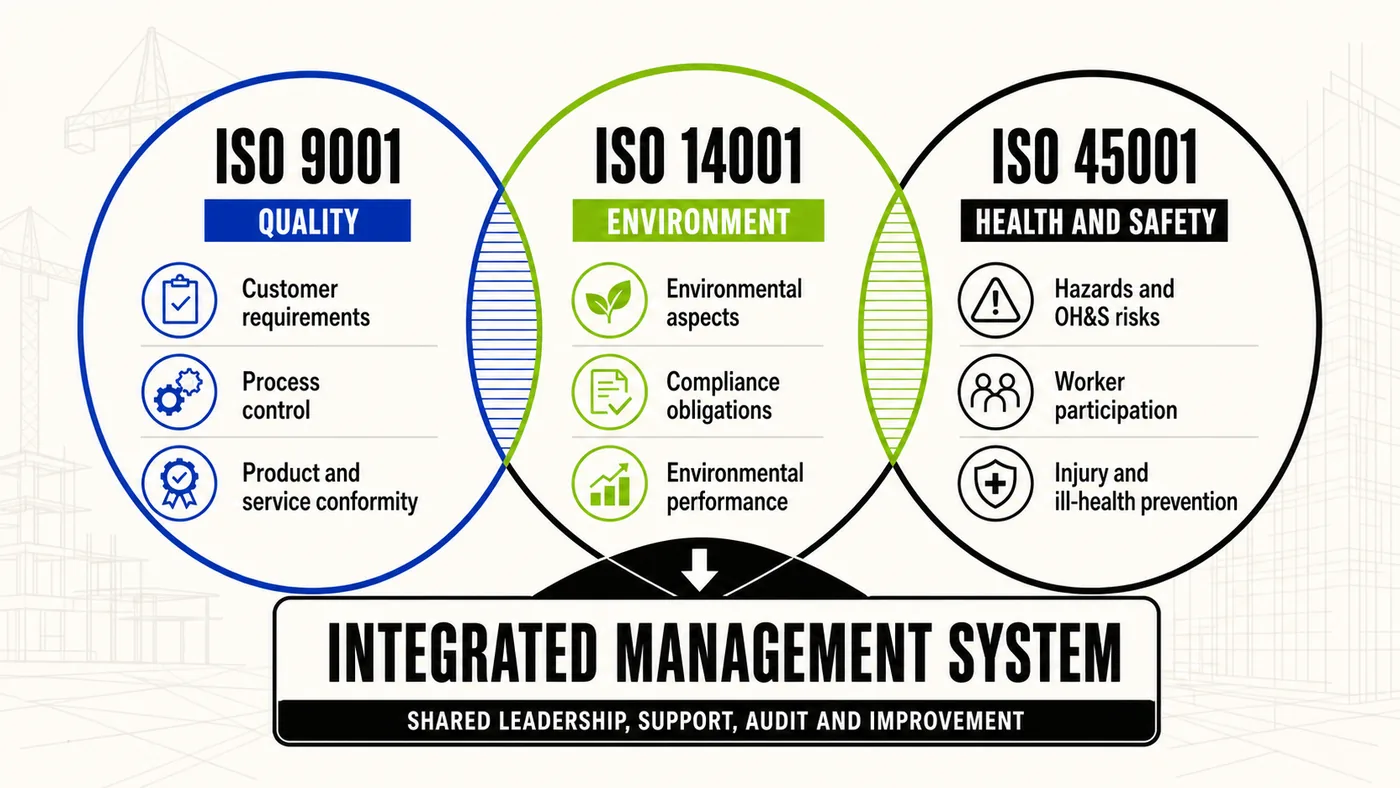
Instead of operating three completely separate systems, an organisation can combine the common requirements of ISO 9001, ISO 14001 and ISO 45001 into one coordinated management system.
However, integration does not mean mixing everything together or ignoring the specific requirements of each standard.
A successful IMS combines the processes that can sensibly be shared while keeping the necessary quality, environmental and occupational health and safety controls clearly defined.
So, let’s have a look at how this works in practice.
What is an Integrated Management System?
An Integrated Management System is a single framework used to manage several areas of organisational performance.
The most common combination includes:
- ISO 9001 for quality management
- ISO 14001 for environmental management
- ISO 45001 for occupational health and safety management
An organisation may also integrate other standards or management systems covering information security, energy, asset management, business continuity or other areas.
The principle remains the same.
Instead of creating a different management structure for every standard, the organisation identifies the requirements that can be managed through common processes.
For example, ISO 9001, ISO 14001 and ISO 45001 all require controls relating to:
- The context of the organisation
- Interested parties
- Leadership
- Risks and opportunities
- Objectives
- Competence
- Awareness
- Communication
- Documented information
- Operational control
- Monitoring and measurement
- Internal audits
- Management review
- Nonconformity and corrective action
- Continual improvement
It makes very little sense to create three completely separate procedures for document control, three audit programmes and three different management review meetings when these activities can be coordinated through one system.
That is the main purpose of an IMS.
It allows the organisation to manage quality, environmental and health and safety performance through one connected set of processes.
What does each management system standard cover?
Before combining the standards, it is important to understand that they do not all have the same purpose.
ISO 9001: Quality Management
ISO 9001 focuses on the organisation’s ability to provide products and services that meet customer, statutory and regulatory requirements.
Its main concerns include:
- Customer requirements
- Process performance
- Product and service conformity
- Customer satisfaction
- Supplier control
- Design and development
- Operational control
- Nonconforming outputs
- Continual improvement
If ISO 9001 is new to you, start with my main ISO 9001 guides and resources and then read the complete explanation of ISO 9001 requirements from Clauses 4 to 10.
ISO 14001: Environmental Management
ISO 14001 focuses on how the organisation manages its environmental responsibilities and improves its environmental performance.
Its requirements include:
- Environmental aspects and impacts
- Compliance obligations
- Environmental objectives
- Life-cycle considerations
- Resource use
- Waste management
- Emissions and pollution prevention
- Emergency preparedness
- Evaluation of environmental performance
As of July 2026, the current published edition is ISO 14001:2026.
ISO 45001: Occupational Health and Safety
ISO 45001 provides a framework for managing occupational health and safety risks and improving OH&S performance.
It covers areas such as:
- Hazard identification
- OH&S risk assessment
- Worker consultation and participation
- Legal and other requirements
- Operational controls
- Contractor and procurement controls
- Emergency preparedness
- Incident investigation
- Prevention of injury and ill health
The current published edition is ISO 45001:2018.
These three systems address different risks, but they operate inside the same organisation.
This is why integration can be extremely useful.
Why are ISO 9001, ISO 14001 and ISO 45001 suitable for integration?
ISO management system standards follow a common harmonised structure.
The main auditable requirements are organised under Clauses 4 to 10:
- Context of the organisation
- Leadership
- Planning
- Support
- Operation
- Performance evaluation
- Improvement
The detailed requirements inside these clauses are not identical, but the overall structure and many of the management processes are aligned.
For example, all three standards require the organisation to:
- Understand its context
- Identify relevant interested parties
- Define the scope of the management system
- Demonstrate leadership
- Establish policies and objectives
- Consider risks and opportunities
- Provide competent people and adequate resources
- Control documented information
- Monitor performance
- Conduct internal audits
- Carry out management reviews
- Address nonconformities
- Continually improve
This common structure makes it possible to create one management framework without losing the specific purpose of each standard.
What can be integrated?
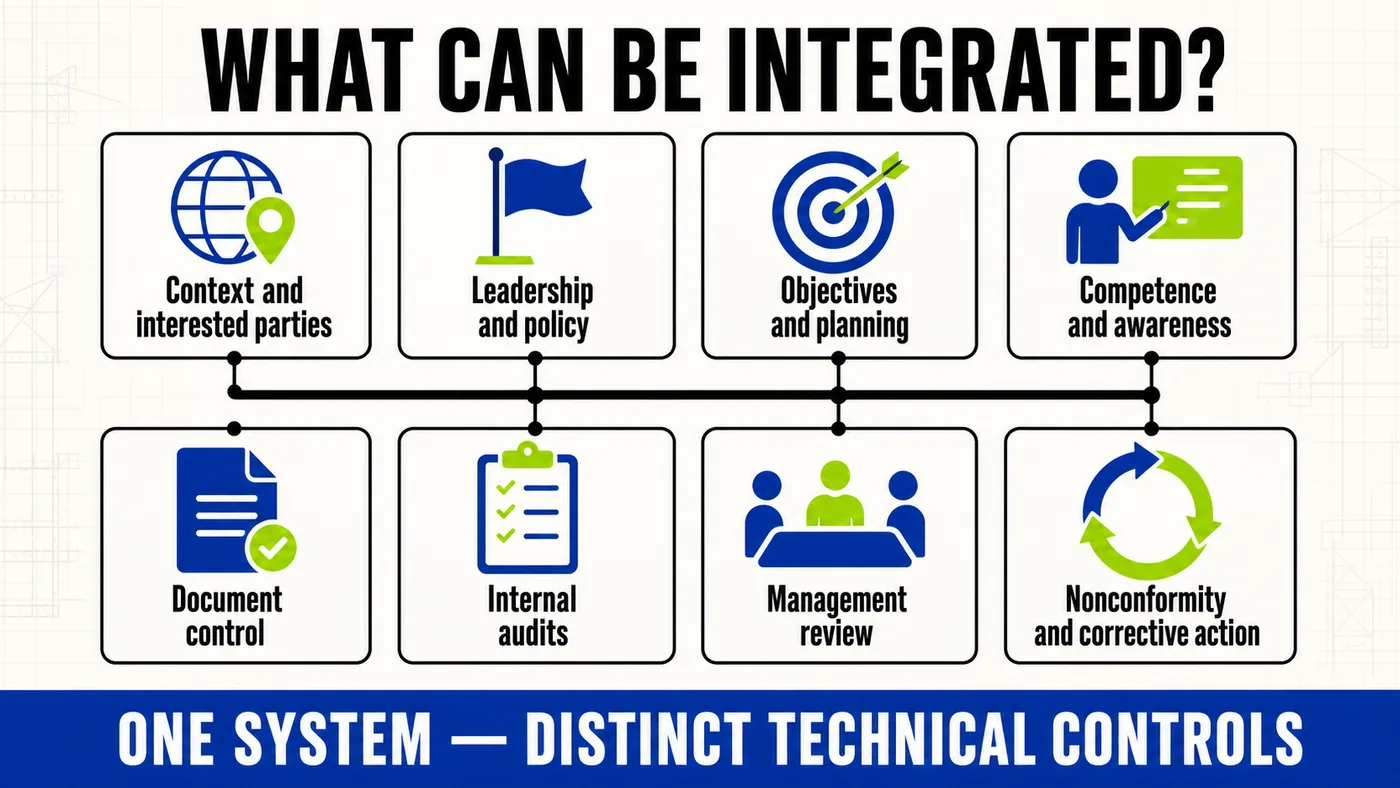
The following processes can normally be managed through one integrated system.
1. Context and interested parties
The organisation can conduct one coordinated review of its internal and external issues.
It can then identify the interested parties relevant to quality, environmental and health and safety performance.
For a construction company, interested parties may include:
- Clients
- Employees
- Subcontractors
- Designers
- Consultants
- Regulators
- Local authorities
- Neighbours
- Emergency services
- Certification bodies
- Insurers
- Members of the public
The requirements of these parties will not all be the same, but they can be maintained in one interested-party register.
2. Scope of the management system
A single IMS scope can describe:
- The organisation and its locations
- Products and services
- Activities and processes
- Applicable standards
- Organisational boundaries
- Relevant exclusions or limitations
The scope should be accurate and must reflect what the organisation actually controls or influences.
3. Leadership and policy
An organisation can establish one integrated policy covering its commitments to:
- Quality
- Customer satisfaction
- Environmental protection
- Compliance obligations
- Safe and healthy working conditions
- Elimination of hazards
- Reduction of OH&S risks
- Worker consultation and participation
- Continual improvement
This does not have to become a three-page statement filled with corporate language.
A good integrated policy should be relevant to the organisation, understood by employees and supported by measurable objectives.
4. Objectives and planning
Quality, environmental and OH&S objectives can be maintained in one objectives register or improvement programme.
| Area | Example objective | Possible measure |
|---|---|---|
| Quality | Reduce construction defects | Number of NCRs per project |
| Environment | Reduce mixed construction waste | Percentage of waste segregated |
| Health and safety | Reduce manual-handling risks | Number of high-risk activities redesigned |
| Integrated | Improve subcontractor performance | Combined supplier performance score |
The objectives should still be clear about which outcome they address.
Combining them in one register does not mean making them vague.
The organisation should connect its objectives with the risks and opportunities that could affect its management system.
5. Competence and training
One competence and training process can cover:
- Quality responsibilities
- Environmental controls
- Health and safety requirements
- Legal competence requirements
- Technical qualifications
- Induction
- Refresher training
- Toolbox talks
- Evidence of competence
For example, a site engineer may require competence in drawing control, inspections, environmental controls and safe working arrangements.
There is no practical reason to maintain four separate competence files for the same person.
Short and practical quality toolbox talks can also be used alongside environmental and safety briefings to reinforce the controls that apply to the work.
6. Communication
The organisation can create one communication process that identifies:
- What must be communicated
- When it must be communicated
- Who receives the information
- Who is responsible
- How the communication is recorded
This could include customer communications, environmental incidents, safety alerts, changes to controlled documents and communications with regulators.
7. Document control
One document-control process should be sufficient for the entire IMS.
It can control:
- Policies
- Procedures
- Forms
- Registers
- Drawings
- Specifications
- Risk assessments
- Environmental plans
- Inspection and Test Plans
- Method Statements
- Records
- External documents
- Legislation and standards
The same rules for approval, revision, distribution, access, retention and prevention of unintended use can apply across the system.
My guide to document control on construction sites explains why uncontrolled revisions can create serious quality and operational problems.
On larger projects, a controlled electronic platform may also be necessary. These cloud-based document collaboration solutions provide examples of the systems commonly used for managing drawings, submissions and records.
8. Internal audits
An integrated audit programme can evaluate several aspects of a process during the same audit.
For example, an audit of the concrete-pouring process could examine:
- Approved drawings and specifications
- Inspection and Test Plan requirements
- Concrete delivery records
- Environmental controls for washout water
- Waste management
- Access and exclusion zones
- Manual-handling risks
- PPE requirements
- Inspection and test records
- Calibration of testing equipment
- Nonconformities and corrective actions
This provides a much better picture of how the process actually operates than three isolated audits conducted by different departments.
Use my ISO 9001 internal audit guide, checklist and example questions to understand how to plan audits, collect evidence and report findings.
9. Management review
One integrated management review meeting can cover the performance of the complete system.
The agenda may include:
- Changes in internal and external issues
- Interested-party requirements
- Customer feedback
- Process performance
- Quality objectives
- Environmental performance
- Environmental objectives
- OH&S performance
- Incidents and accidents
- Compliance obligations
- Audit results
- Supplier and subcontractor performance
- Nonconformities
- Corrective actions
- Resources
- Risks and opportunities
- Opportunities for improvement
However, the meeting must genuinely evaluate all three systems.
Calling it an integrated review while spending 90% of the meeting discussing safety statistics is not proper integration.
10. Nonconformity and corrective action
One corrective-action process can be used for:
- Product or service nonconformities
- Customer complaints
- Environmental incidents
- Permit breaches
- Safety incidents
- Audit findings
- Process failures
- Supplier problems
The classification of the issue should remain clear, but the basic process can be shared:
- Control and correct the immediate problem.
- Deal with its consequences.
- Investigate why it happened.
- Determine whether similar problems could occur elsewhere.
- Implement corrective action.
- Verify whether the action was effective.
- Update risks and controls where necessary.
My practical guides to root cause analysis methods and examples and ISO 9001 nonconformity and corrective action provide more detail on this process.
What should not be combined?
Integration does not mean converting every activity into one generic process.
Some requirements remain technically distinct and should be controlled by people with the appropriate competence.
Quality-specific controls
These may include:
- Customer and contract review
- Design and development controls
- Product specifications
- Inspection and testing
- Acceptance criteria
- Traceability
- Control of nonconforming outputs
- Customer satisfaction
- Product release
Environmental-specific controls
These may include:
- Environmental aspect assessments
- Compliance obligations
- Waste controls
- Pollution prevention
- Emissions
- Resource consumption
- Biodiversity considerations
- Environmental emergency planning
- Life-cycle considerations
OH&S-specific controls
These may include:
- Hazard identification
- OH&S risk assessment
- Worker consultation and participation
- Hierarchy of controls
- Safe systems of work
- Health surveillance
- Incident investigation
- Emergency response
- Elimination of hazards
These processes can operate within the same management framework, but their technical content should not be diluted.
One integrated system must not become one generic risk register containing thousands of unrelated items that nobody can manage properly.
An Integrated Management System in construction
Let’s use a concrete pour as a practical example.
From a quality perspective, the organisation may need to control:
- Approved drawings
- Reinforcement inspections
- Formwork inspections
- Concrete specifications
- Delivery tickets
- Slump testing
- Cube testing
- Pour records
- Curing arrangements
From an environmental perspective, it may need to control:
- Concrete washout
- Water pollution
- Waste concrete
- Noise
- Vehicle emissions
- Material storage
- Spill response
From a health and safety perspective, it may need to control:
- Concrete-pump positioning
- Exclusion zones
- Delivery-vehicle movements
- Working at height
- Manual handling
- Chemical exposure
- Access and lighting
- Emergency arrangements
These are different controls, but they apply to the same activity.
A properly integrated system coordinates them through:
- One planning process
- One approved method of work
- Clearly allocated responsibilities
- Coordinated briefings
- Controlled documents
- Combined inspections
- Recorded evidence
- One process for reporting and correcting problems
This is what integration should look like on the ground.
It is not simply putting three logos on the front page of a procedure.
Construction companies can find more industry-specific advice in my guide to building an ISO 9001 Quality Management System that works on site and the main construction quality management pillar guide.

Benefits of an Integrated Management System
Reduced duplication
The organisation can remove repeated policies, procedures, registers, audit programmes and meetings.
Clearer responsibilities
Managers and employees can understand how their responsibilities affect quality, environmental and health and safety outcomes.
Better decision-making
Management receives a more complete picture of operational performance.
A proposed change may improve productivity but introduce environmental or safety risks. An integrated system encourages these consequences to be considered together.
More effective audits
Integrated audits follow processes rather than departmental boundaries.
This makes it easier to identify gaps between planning and actual operational control.
Consistent corrective action
Problems can be investigated through one structured process, allowing common causes to be identified across the organisation.
Improved risk management
Quality, environmental and OH&S risks can be considered during operational and strategic decisions.
Less bureaucracy
A good IMS reduces paperwork and makes controls easier to follow.
A badly designed IMS simply puts all the paperwork into one very large manual.
The difference is important.
Common challenges when integrating management systems
Departmental resistance
Quality, environmental and safety departments may be used to controlling their own systems.
Integration can be seen as a loss of authority unless roles and responsibilities are properly discussed.
Overintegration
Not every document or technical process needs to be combined.
Trying to create one universal form for every possible situation usually produces a form that is useful for none of them.
Generic procedures
Procedures may become so general that they no longer explain how work is actually controlled.
Uneven attention
One system can dominate the IMS.
For example, a construction organisation may have strong safety controls but weak quality planning and environmental monitoring.
Lack of competence
An integrated auditor does not need to be the organisation’s leading expert in every subject.
However, the audit team must collectively have enough competence to evaluate the quality, environmental and OH&S requirements being audited.
Integration only on paper
The organisation may issue an integrated policy and manual while continuing to operate three separate systems.
Real integration must be visible in everyday planning, communication, operational control, auditing and decision-making.
How to implement an Integrated Management System
Step 1: Understand the organisation
Review:
- Organisational context
- Strategic direction
- Products and services
- Locations
- Activities and processes
- Interested parties
- Legal and contractual requirements
- Existing management systems
Step 2: Define the IMS scope
Clearly establish which operations, locations and activities will be covered.
Step 3: Carry out a gap analysis
Compare the organisation’s existing arrangements against the requirements of the applicable standards.
Identify:
- Processes already operating effectively
- Requirements that can be integrated
- Technical controls that must remain distinct
- Missing processes
- Duplicate documents
- Unclear responsibilities
If ISO 9001 is your starting point, use my guide on how to implement ISO 9001 step by step as the basic implementation structure.
Step 4: Map the organisation’s processes
Identify the organisation’s real processes before writing procedures.
These may include:
- Sales and tendering
- Contract review
- Design
- Procurement
- Supplier management
- Project planning
- Construction or service delivery
- Inspection and testing
- Environmental control
- Health and safety control
- Customer handover
- Performance monitoring
- Improvement
Then determine where quality, environmental and OH&S requirements apply to each process.
Step 5: Establish integrated leadership arrangements
Define:
- IMS leadership responsibilities
- Process owners
- Quality responsibilities
- Environmental responsibilities
- OH&S responsibilities
- Reporting lines
- Worker consultation arrangements
- Escalation routes
Step 6: Develop the integrated policy and objectives
Make sure the policy contains the necessary commitments and the objectives are measurable.
Step 7: Create a practical document structure
A typical IMS document structure may include:
- IMS scope
- Integrated policy
- Process map
- Roles and responsibilities
- Risks and opportunities register
- Environmental aspects register
- Hazard and OH&S risk assessments
- Legal and compliance register
- Objectives programme
- Operational procedures
- Emergency plans
- Inspection and monitoring plans
- Audit programme
- Management review records
- Nonconformity and corrective-action register
Only create documents that help the organisation control its processes or demonstrate conformity.
Step 8: Implement operational controls
This is where the system becomes real.
Controls must be incorporated into:
- Project plans
- Method Statements
- Procurement
- Design reviews
- Supplier controls
- Work instructions
- Inspections
- Maintenance
- Emergency arrangements
- Site supervision
- Records
Construction teams should also use appropriate Inspection and Test Plans to connect specifications, inspections, tests, responsibilities and acceptance criteria.
Step 9: Train and involve people
Employees should understand:
- The integrated policy
- Relevant objectives
- Their responsibilities
- Significant environmental aspects
- Hazards and OH&S risks
- Quality controls
- Consequences of failing to follow the system
- How to report problems and opportunities
Step 10: Monitor performance
Use meaningful indicators such as:
- Customer complaints
- Defect rates
- Rework costs
- Inspection results
- Waste quantities
- Energy and water consumption
- Environmental incidents
- Safety observations
- Lost-time injuries
- Audit findings
- Corrective-action completion
- Supplier performance
Do not create an impressive dashboard filled with indicators that nobody uses.
My guide on how to measure quality in construction projects explains how inspections, NCRs, document-control data, audits and customer feedback can be converted into useful performance information.
You can also review these seven practical quality metrics for construction projects.
Step 11: Conduct integrated internal audits
Audit complete processes and follow the interaction between planning, execution, monitoring and improvement.
Step 12: Complete the management review
Senior management should evaluate the performance, suitability, adequacy and effectiveness of the IMS.
Step 13: Correct problems and improve
Use audit findings, incidents, complaints, monitoring results and employee feedback to improve the system.
Can an Integrated Management System be certified?
Yes.
An organisation can arrange a combined certification audit covering ISO 9001, ISO 14001 and ISO 45001.
The certification body will still evaluate conformity against the individual requirements of each standard.
A combined audit may reduce duplication because common processes can be audited together, but it does not reduce the level of evidence required.
The organisation must demonstrate that:
- The integrated system meets the requirements of every applicable standard.
- Discipline-specific risks are properly controlled.
- Relevant personnel are competent.
- Internal audits cover all applicable requirements.
- Management review evaluates the complete system.
- Operational controls are implemented effectively.
If certification is one of your objectives, read my guide to the ISO 9001 certification process, costs and timescales.
Common Integrated Management System mistakes
Avoid the following:
- Combining documents without integrating processes.
- Creating an IMS manual that nobody uses.
- Using one generic risk assessment for everything.
- Allowing one standard to dominate the system.
- Removing necessary technical procedures in the name of simplification.
- Conducting audits against clauses without following actual processes.
- Excluding workers from health and safety decisions.
- Treating legal compliance as an annual paperwork exercise.
- Setting vague objectives that cannot be measured.
- Failing to connect corrective actions with risks and operational controls.
- Maintaining duplicate registers under different departments.
- Assuming that integration automatically means less work.
The purpose of integration is not simply to reduce documents.
It is to make the organisation easier to manage.
Frequently asked questions
What is the difference between an IMS and a QMS?
A Quality Management System focuses on quality and customer requirements.
An Integrated Management System combines two or more management disciplines, such as quality, environmental management and occupational health and safety.
Is an Integrated Management System mandatory?
No.
An organisation may operate separate systems or an integrated system.
Integration is usually more practical when several ISO management system standards apply to the same organisation and processes.
Do we need one integrated manual?
No.
ISO management system standards do not require an integrated manual.
The organisation should maintain the documented information necessary for the effective operation of its processes.
Can we have separate policies?
Yes.
An organisation may use one integrated policy or separate policies.
The important point is that every required commitment is covered, communicated and implemented.
Can quality, environmental and safety risks be kept in one register?
They can, provided the register remains practical and the different assessment methods are properly applied.
In many organisations, it is more useful to maintain a strategic IMS risks-and-opportunities register together with separate operational registers for environmental aspects and OH&S hazards.
Can one person manage the entire IMS?
Possibly, depending on the size, complexity and risks of the organisation.
However, one IMS manager should not be expected to possess every piece of technical expertise.
Process owners, operational managers, workers and subject specialists must remain involved.
Does integration reduce certification audit time?
Combined certification audits can reduce some duplication, but the certification body must still audit the applicable requirements of every standard.
The actual audit duration depends on factors such as organisational size, complexity, scope, locations and the level of integration.
Final thoughts
An Integrated Management System should not be treated as an exercise in combining three sets of documents.
Its purpose is to create one effective way of managing the organisation.
Quality, environmental and health and safety requirements often affect the same processes, people, suppliers and operational decisions.
Managing them separately can create gaps, conflicting priorities and repeated work.
Managing them through one coordinated framework can improve communication, accountability and decision-making.
However, the organisation must maintain the technical controls required by each discipline.
The best IMS is not necessarily the one with the fewest documents.
It is the one that allows people to understand what must be done, why it must be done, who is responsible and how the organisation knows that its controls are working.
That is what a management system should achieve in the first place.
Need practical quality management templates?
If you are building or improving a construction management system, the 12 Essential Quality Documents Pack for Construction includes editable templates for inspections, audits, NCRs, corrective actions, quality reporting and project records.
You can also browse the complete collection of ISO 9001 and construction quality management guides for further practical guidance.