

ISO 9001 quality objectives turn an organisation’s general commitments into specific results that can be measured, monitored and reviewed.
A Quality Policy may commit a business to reliable delivery, customer satisfaction, reduced defects and continual improvement. Those commitments provide direction, but they do not explain exactly what the organisation intends to achieve or how success will be evaluated.
That is the purpose of quality objectives.
Unfortunately, many organisations set objectives such as “improve quality”, “reduce complaints” or “provide excellent service”. They may sound positive, but they are difficult to measure and almost impossible to manage.
In my experience, the most useful quality objectives are connected to genuine business priorities. They have a clear measure, a realistic target, an accountable owner and a defined review process. Management can see whether performance is improving, employees understand what matters and auditors can follow the evidence.
This guide explains the ISO 9001 requirements for quality objectives, the difference between objectives, KPIs and targets, how to write measurable objectives and how to monitor them. It also includes practical examples and a template that can be adapted for different industries and departments.
If you are developing the wider system rather than objectives alone, my guide to implementing ISO 9001 step by step explains how objectives fit alongside process controls, competence, documented information, audits and management review.
Building or reviewing an ISO 9001 Quality Management System? Visit the ISO 9001 resource hub or use the free ISO 9001 Starter Checklist to review Clauses 4 to 10 and identify gaps in your current system.
What are ISO 9001 quality objectives?
ISO 9001 quality objectives are measurable results that an organisation establishes at relevant functions, levels and processes within its Quality Management System.
They translate the organisation’s Quality Policy and strategic priorities into defined outcomes.
A quality objective may relate to:
- Customer satisfaction
- Product or service conformity
- On-time delivery
- Defects, rework or waste
- Process performance
- Supplier performance
- Employee competence
- Audit-programme completion
- Corrective-action closure
- Document-approval times
- Inspection and testing performance
- Handover readiness
The objective should be relevant to the organisation and the results its QMS is expected to achieve.
A factory may focus on rejected products and production yield. A consultancy may focus on delivery times, customer feedback and report accuracy. A construction contractor may focus on inspection pass rates, repeat NCRs, rework costs and handover documentation.
ISO 9001 provides the framework, but the organisation decides which objectives are meaningful.
Are quality objectives mandatory under ISO 9001?
Yes. ISO 9001:2015 Clause 6.2 requires the organisation to establish quality objectives at relevant functions, levels and processes.
The objectives must be maintained as documented information. The organisation also needs to plan how they will be achieved.
ISO 9001 does not specify a mandatory number of objectives. It does not require every department to maintain exactly three KPIs, and it does not prescribe one standard register or dashboard.
The number and level of objectives should reflect:
- The organisation’s size and complexity
- Its products and services
- Its processes and locations
- Customer and applicable legal requirements
- Risks and opportunities
- Strategic priorities
- Current performance weaknesses
For a wider explanation of where Clause 6.2 sits within the Standard, read my guide to ISO 9001 requirements and Clauses 4 to 10.
What does ISO 9001 Clause 6.2 require?
The explanation below paraphrases the requirements in practical language. It does not reproduce the copyrighted text of ISO 9001.
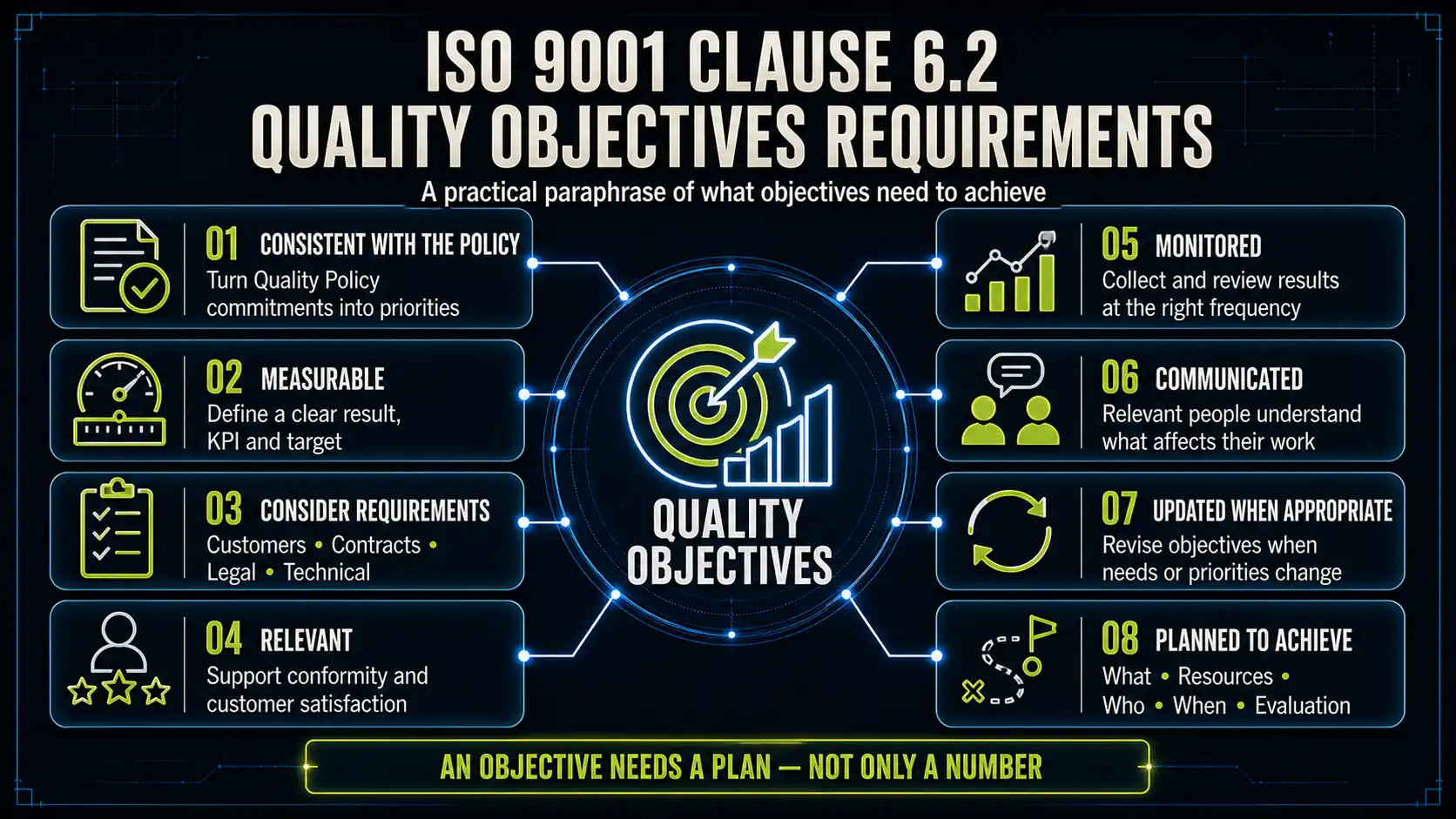
Objectives must be consistent with the Quality Policy
The Quality Policy provides overall direction. The quality objectives should turn that direction into measurable priorities.
If the policy commits the organisation to reliable delivery, there should normally be an objective or performance measure relating to delivery. If the policy emphasises customer satisfaction, the organisation should evaluate customers’ perceptions. If it commits to improvement, management should be able to identify what it is trying to improve.
Your objectives do not need to repeat every sentence of the policy. However, the two should make sense together.
My guide to the ISO 9001 Quality Policy explains how policy commitments provide the framework for objectives.
Objectives must be measurable
The organisation needs a clear way to determine whether an objective has been achieved.
For example:
- Weak: Improve on-time delivery.
- Measurable: Achieve at least 95% on-time delivery each month by 31 December.
- Weak: Reduce customer complaints.
- Measurable: Reduce valid customer complaints from an average of 12 per month to no more than eight per month by the end of Quarter 4.
- Weak: Close corrective actions promptly.
- Measurable: Close at least 90% of corrective actions within 30 calendar days.
Measurement does not always require a percentage. The measure could be a count, cost, time, score, completion rate, defect rate or milestone.
Objectives must take applicable requirements into account
Objectives should reflect requirements that affect the organisation’s ability to provide conforming products and services.
These may include:
- Customer requirements
- Contracts
- Statutory and regulatory obligations
- Technical standards
- Product specifications
- Service-level agreements
- Internal requirements
A regulated manufacturer may need objectives relating to product release, traceability or validation. A contractor may need objectives for inspection records, technical submissions or handover deliverables.
Objectives must be relevant to conformity and customer satisfaction
An objective should contribute to the organisation’s ability to meet requirements or improve customer satisfaction.
This does not mean that every objective needs to mention customers directly. Improving competence, supplier performance or document control may improve conformity and customer outcomes indirectly.
A measure can be interesting without being useful. The number of meetings held, emails sent or forms completed may be easy to count, but it does not necessarily show that quality performance has improved.
Objectives must be monitored
The organisation should collect and review information at an appropriate frequency.
A monthly measure may be suitable for complaints, delivery performance and NCR closure. An annual review may be too slow to identify problems. Other objectives, such as completing a certification programme or introducing new software, may be monitored against project milestones.
The frequency should allow action to be taken before failure becomes unavoidable.
Objectives must be communicated
Relevant people should understand the objectives that affect their work.
Employees do not need to memorise the complete corporate objectives register. A production supervisor should understand relevant defect and output targets. A procurement team should understand supplier-performance objectives. A project team should know the inspection, NCR and handover priorities that affect delivery.
Communication can take place through:
- Team meetings
- Departmental plans
- Dashboards
- Project Quality Plans
- Performance reviews
- Briefings and toolbox talks
- Management-review outputs
Objectives must be updated where appropriate
Objectives should not remain unchanged simply because they were approved several years ago.
They may need to be revised when:
- An objective has been achieved
- Business priorities change
- A new risk or opportunity emerges
- Customer or legal requirements change
- Performance data reveals a different weakness
- The QMS scope changes
- A target proves unrealistic or no longer meaningful
Updating an objective does not mean hiding poor performance. The reason for the change should be understood and recorded.
The organisation must plan how objectives will be achieved
Setting a target is not enough. The organisation should determine:
- What will be done
- What resources will be required
- Who will be responsible
- When the action will be completed
- How the result will be evaluated
This planning requirement is frequently missed.
Management sets an objective to reduce defects by 20%, but nobody decides what needs to change. Twelve months later, the result is reviewed and everyone is surprised that the target was missed.
An objective needs a plan—not only a number.
Quality Policy, objective, KPI and target: what is the difference?
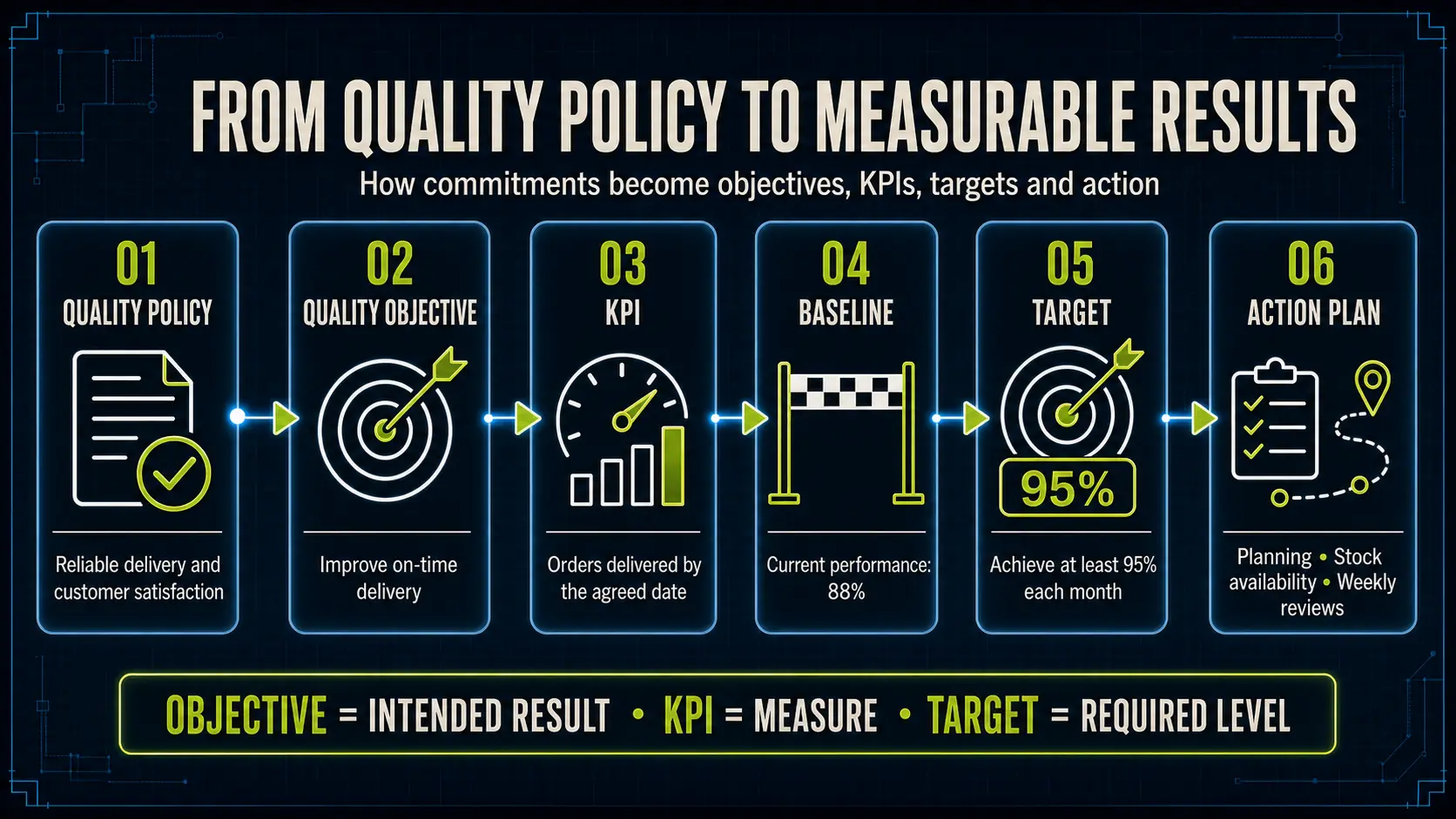
These terms are related but do not mean the same thing.
| Term | Meaning | Example |
|---|---|---|
| Quality Policy | Overall direction and commitments established by top management | We are committed to reliable delivery and customer satisfaction. |
| Quality objective | The result the organisation intends to achieve | Improve on-time delivery. |
| KPI | The indicator used to monitor performance | Percentage of orders delivered on or before the agreed date. |
| Baseline | The starting performance level | 88% on-time delivery. |
| Target | The desired performance level | At least 95%. |
| Action plan | The work required to achieve the target | Improve production planning, confirm stock availability and review late deliveries weekly. |
One objective may be monitored through more than one KPI. However, adding too many measures can hide the result that really matters.
Are all KPIs quality objectives?
No.
An organisation may monitor many KPIs as part of normal management:
- Sales revenue
- Profit margin
- Employee turnover
- Equipment utilisation
- Website enquiries
- Stock levels
- Project progress
Some may influence the QMS, but they are not automatically ISO 9001 quality objectives.
Quality objectives are the selected results established under the QMS and managed according to Clause 6.2. KPIs are the indicators used to understand performance.
The organisation should avoid creating a separate quality-measurement universe disconnected from normal business management. Where appropriate, quality objectives should be integrated into existing operational and strategic reporting.
Should quality objectives be SMART?
ISO 9001 does not require the word SMART or mandate the acronym.
Nevertheless, the SMART framework is a useful way to test whether an objective is workable:
- Specific: Is the intended result clear?
- Measurable: Can performance be evaluated?
- Achievable: Is the target realistic with appropriate action and resources?
- Relevant: Does it matter to the QMS, conformity or customer satisfaction?
- Time-bound: Is there a deadline or review period?
For example:
By 31 December, reduce the average number of valid customer complaints from 12 to no more than eight per month through improved order review, employee training and monthly analysis of complaint causes.
This statement identifies the result, measure, baseline, target, deadline and broad method.
Do not force every objective into an awkward sentence. A structured register can present the same information more clearly.
How to establish ISO 9001 quality objectives
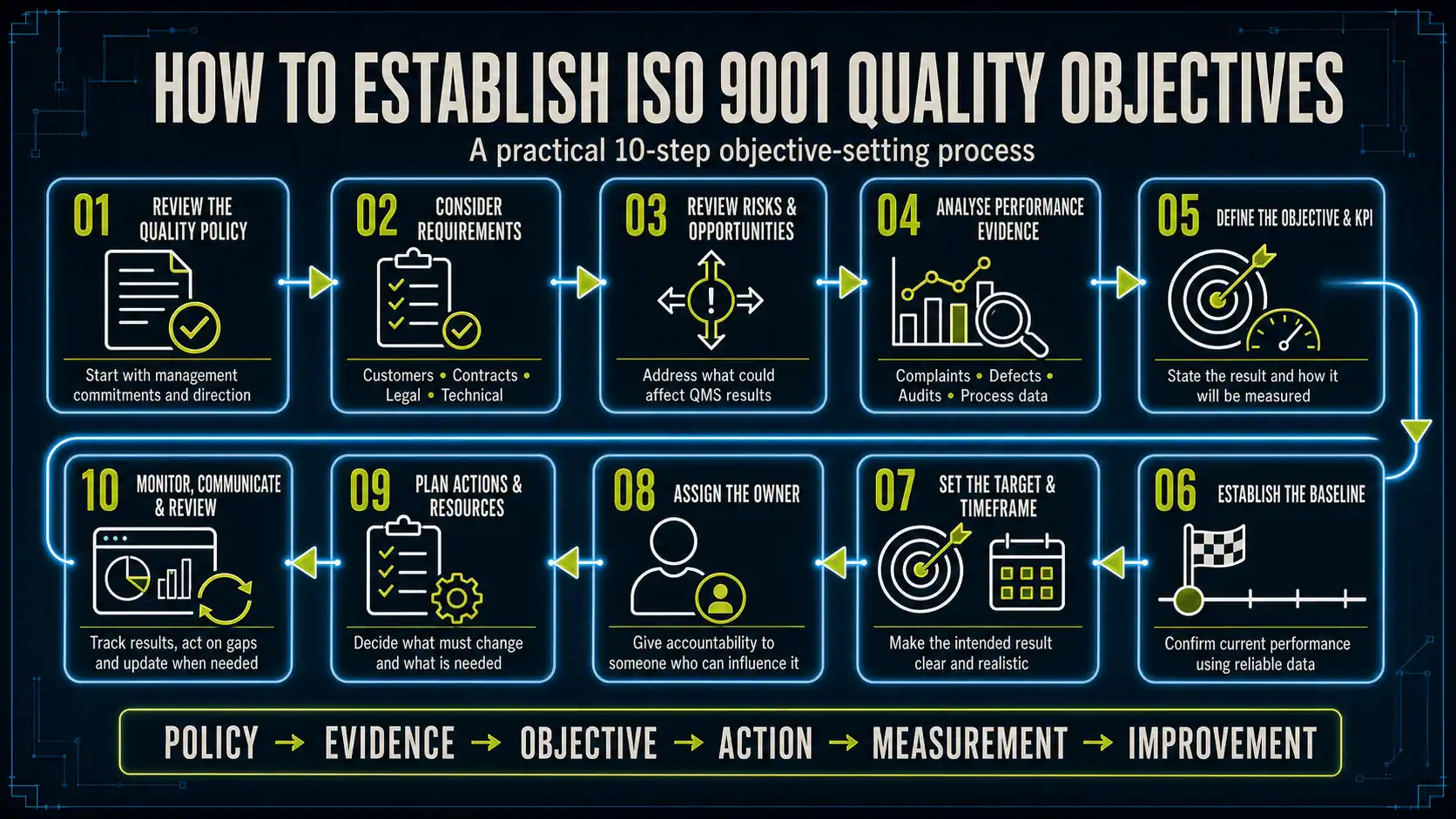
Step 1: Start with the Quality Policy and strategic direction
Review the commitments top management has made and the direction of the business.
Ask:
- What results are essential to our customers?
- What aspects of conformity matter most?
- Which policy commitments need measurable evidence?
- What does management want the organisation to improve?
Step 2: Review requirements, risks and opportunities
Consider customer, contractual, statutory, regulatory and internal requirements.
Review significant ISO 9001 risks and opportunities. Objectives can help reduce important risks or realise opportunities.
For example, if the organisation risks losing customers because of late delivery, an on-time-delivery objective may be appropriate. If inconsistent training is causing errors, a competence objective may be more useful than another general defect target.
Step 3: Use evidence to identify priorities
Review available information, including:
- Customer feedback
- Complaints
- Defect and rework data
- Audit results
- Corrective actions
- Supplier performance
- Process measures
- Delivery performance
- Employee competence
- Management-review decisions
Objectives should respond to actual needs rather than being copied from an ISO 9001 example list.
Step 4: Define the objective and KPI
State the intended result and decide how it will be measured.
Define the calculation clearly. “On-time delivery” could mean dispatch date, arrival date or completion date. Different departments may produce different results unless the definition is agreed.
Step 5: Establish a reliable baseline
A baseline helps management set a realistic target and understand improvement.
If reliable historical data is unavailable, the first objective may be to establish the measurement system and collect sufficient baseline information.
Do not invent a baseline to make the register look complete.
Step 6: Set a target and timeframe
A good target should be challenging enough to matter but credible enough to guide action.
Consider:
- Current performance
- Customer expectations
- Contractual targets
- Industry benchmarks
- Available resources
- Planned changes
- Risks created by pursuing the target
A target of zero defects may be aspirational, but it may not be a useful management target for every process. It can encourage people to hide or reclassify defects rather than report them honestly.
Step 7: Assign an accountable owner
The owner should have enough authority and access to influence the result.
The Quality Manager should not automatically own every quality objective. Operations should own operational performance. Procurement should influence supplier performance. Department managers should own the results produced by their processes.
The Quality function can coordinate reporting, challenge evidence and support improvement without taking ownership away from process managers.
Step 8: Plan the actions and resources
Identify the work needed to achieve the objective.
For a defect-reduction objective, actions might include:
- Analyse the main defect categories
- Investigate recurring causes
- Revise work instructions
- Improve training
- Change inspection stages
- Review supplier controls
- Modify equipment or tooling
- Verify the effectiveness of completed actions
Step 9: Agree monitoring and escalation
Define:
- Who collects the data
- Where the source data comes from
- How the KPI is calculated
- How often it is reported
- Who reviews the result
- What triggers corrective or recovery action
Step 10: Approve and communicate the objectives
Relevant management should approve the objectives and provide the necessary resources.
Communicate each objective to the people who can influence it. Explain the purpose, measure and expected actions—not just the target number.
ISO 9001 quality-objective examples
The following examples illustrate how objectives, KPIs and targets can work together. They should be adapted to the organisation’s circumstances and baseline performance.
| Quality objective | KPI | Example target |
|---|---|---|
| Improve on-time delivery | Orders delivered by the agreed date | At least 95% each month |
| Reduce customer complaints | Valid complaints received | Reduce from 12 to no more than eight per month |
| Improve customer satisfaction | Average customer-satisfaction score | At least 85% |
| Reduce product defects | Rejected units as a percentage of production | No more than 1.5% |
| Improve corrective-action closure | Corrective actions closed within 30 days | At least 90% |
| Improve supplier performance | Approved deliveries accepted without rejection | At least 98% |
| Complete the internal-audit programme | Planned audits completed by the scheduled date | 100% |
| Improve employee competence | Required competence assessments completed | 100% by 30 September |
| Reduce document-approval delays | Average approval turnaround time | Reduce from ten to seven working days |
| Reduce rework cost | Rework cost as a percentage of revenue | Below 2% |
Quality objectives by department
| Department or process | Example objective | Possible KPI |
|---|---|---|
| Sales and contract review | Improve the accuracy of accepted customer requirements | Orders requiring correction after acceptance |
| Design | Reduce design errors identified after release | Post-release design changes caused by internal error |
| Procurement | Improve critical-supplier performance | Accepted deliveries and on-time delivery rate |
| Production | Reduce rejected output | First-pass yield or rejection rate |
| Service delivery | Complete services within agreed timescales | Jobs completed by the contractual deadline |
| Quality | Improve corrective-action effectiveness | Repeated findings after action closure |
| Human resources | Ensure employees are competent for assigned roles | Required competence assessments completed |
| Customer service | Respond to complaints promptly | Complaints acknowledged within one working day |
| Document control | Improve document review and approval performance | Average approval time and overdue submissions |
| Top management | Complete agreed improvement actions | Management-review actions completed by the due date |
Departmental objectives should still support the overall QMS. They should not become isolated targets that encourage one department to improve its score by creating problems elsewhere.
ISO 9001 quality objectives for construction companies
Construction quality objectives need to reflect the way projects are designed, procured, built, inspected and handed over.
My guide to ISO 9001 for construction companies explains how company-level QMS processes connect with project controls.
| Construction objective | KPI | Example target |
|---|---|---|
| Reduce repeat NCRs | NCRs repeating a previously identified cause | Reduce by 25% within 12 months |
| Improve NCR closure | NCRs closed within the agreed period | At least 90% |
| Improve first-time inspection acceptance | Inspections accepted at first submission | At least 92% |
| Reduce rework | Rework cost as a percentage of project value | Below 1.5% |
| Improve ITP implementation | Required inspections completed and recorded | At least 98% |
| Improve technical-submission approval | Submissions approved without major resubmission | At least 85% |
| Improve document turnaround | Average time to review and issue controlled documents | No more than seven working days |
| Improve subcontractor quality performance | Subcontractors achieving the agreed score | At least 90% |
| Improve handover readiness | Required handover records accepted by the planned date | At least 95% |
| Reduce defects at completion | Significant defects recorded during handover | Reduce by 20% against comparable projects |
The article on how to measure quality in construction projects explains these types of construction KPIs in greater detail.
Quality objectives for manufacturing
Manufacturing objectives may include:
- Increase first-pass yield from 94% to 97%
- Reduce internal rejection below 1.5% of production
- Reduce customer returns by 20%
- Achieve at least 98% supplier acceptance
- Maintain at least 95% on-time delivery
- Complete 100% of planned calibration activities on time
- Reduce scrap cost by 15%
- Close 90% of corrective actions within 30 days
The target should be based on the process, product risks and reliable historical information—not copied from another manufacturer.
Quality objectives for service companies
Service businesses may use objectives such as:
- Complete at least 95% of services within agreed timescales
- Achieve an average customer-satisfaction score above 85%
- Acknowledge 100% of complaints within one working day
- Reduce reports returned for correction by 20%
- Maintain consultant utilisation without reducing service quality
- Complete required competence reviews by the planned date
- Reduce missed appointments to below 2%
- Improve first-contact resolution to at least 80%
Service conformity can be less visible than a defective product, so clear definitions and reliable customer feedback are particularly important.
Quality objectives for small businesses
A small organisation does not need dozens of objectives.
Three to five meaningful objectives may provide better control than a complicated dashboard nobody maintains.
For example:
- Achieve at least 95% on-time delivery each month.
- Maintain an average customer-satisfaction score above 85%.
- Close all valid complaints within ten working days.
- Complete the annual internal-audit programme by 30 November.
- Complete all required employee competence assessments by 30 September.
As the business grows and data improves, the objectives can become more specific.
ISO 9001 quality-objectives template
The following structure can be copied into a spreadsheet, document or QMS platform.
| Field | Information to record |
|---|---|
| Objective ID | Unique reference |
| Quality objective | Clear description of the intended result |
| Related policy commitment | The Quality Policy theme supported by the objective |
| Process or department | Where the objective applies |
| KPI and calculation | The measure and how it is calculated |
| Data source | System, register or record providing the evidence |
| Baseline | Current or previous performance |
| Target | The required result |
| Owner | Person accountable for the objective |
| Resources | People, budget, equipment, training or systems required |
| Actions | Planned work needed to achieve the result |
| Deadline | Completion date or target period |
| Review frequency | Weekly, monthly, quarterly or milestone-based review |
| Current result | Latest measured performance |
| Status | On track, at risk, off track or achieved |
| Recovery action | Action required when performance is below target |
Completed quality-objective example
| Objective ID | QO-01 |
|---|---|
| Objective | Improve on-time delivery to customers |
| Policy commitment | Reliable delivery and customer satisfaction |
| KPI | Orders delivered on or before the confirmed customer date ÷ total orders delivered × 100 |
| Baseline | 88% |
| Target | At least 95% each month by 31 December |
| Owner | Operations Manager |
| Resources | Planning software improvements and weekly coordination time |
| Actions | Review capacity planning, confirm material availability before accepting dates, analyse every late delivery and escalate shortages weekly |
| Review frequency | Monthly |
| Current result | 92% |
| Status | At risk |
| Recovery action | Review recurring material shortages with Procurement and revise safety-stock levels for critical components |
How to monitor quality objectives
Monitoring should be systematic but proportionate.
A practical process is:
- Collect information from the agreed data source.
- Check the completeness and accuracy of the data.
- Calculate the KPI consistently.
- Compare the result with the baseline and target.
- Identify trends rather than reviewing one isolated number.
- Record explanations for significant changes.
- Assign recovery or improvement actions where required.
- Escalate issues that need management decisions or resources.
- Review whether actions improve the result.
The organisation should avoid changing calculation methods without explanation. A KPI can appear to improve simply because the definition or data source changed.
Using dashboards and RAG status
A dashboard can help management see performance quickly.
Objectives are often classified as:
- Green: On target or achieved
- Amber: At risk or slightly below target
- Red: Significantly below target or recovery action required
The thresholds should be defined. Otherwise, status can become subjective.
Colour should never replace analysis. A red indicator should lead to questions:
- What caused the result?
- Is the data reliable?
- Is this a one-off event or a trend?
- What action has been taken?
- Does management need to provide resources?
- Has the risk profile changed?
What if a quality objective is not achieved?
Failing to meet an objective does not automatically mean that the organisation has failed ISO 9001.
An objective is a planned result, and genuine improvement targets may not always be achieved.
The important questions are:
- Was the result monitored?
- Was the shortfall identified?
- Was the cause understood?
- Were appropriate actions taken?
- Were resources and risks reconsidered?
- Was the objective or plan updated where justified?
- Did management review the issue?
Repeatedly missing the same target without analysis or action suggests that the planning and monitoring process is ineffective.
Where the shortfall results from a process failure or recurring nonconformity, the organisation may need to use its nonconformity and corrective-action process.
Quality objectives and management review
Progress against quality objectives is an important management-review input.
Top management should consider:
- Which objectives have been achieved
- Which are at risk or overdue
- Performance trends
- The effectiveness of actions
- Resource constraints
- Whether targets remain suitable
- Whether new objectives are required
- Whether the Quality Policy or strategic direction has changed
The review should lead to decisions, not merely a presentation of coloured charts.
My practical guide to ISO 9001 management review explains the required inputs, outputs, agenda and action process.
What do ISO 9001 auditors look for?
An auditor may examine whether:
- Objectives have been established at relevant functions, levels and processes
- They are consistent with the Quality Policy
- They are measurable and relevant
- Applicable requirements were considered
- Owners and responsibilities are defined
- Actions, resources and timescales were planned
- Reliable evidence supports the reported results
- Objectives are communicated to relevant people
- Performance is monitored at an appropriate frequency
- Management acts when results are below target
- Objectives are updated where appropriate
- Documented information is maintained and controlled
An auditor may trace one objective from the Quality Policy through the register, source data, departmental actions and management-review decisions.
A strong ISO 9001 internal audit should test the same connections before the certification audit. If certification is your objective, my guide to the ISO 9001 certification process, cost and timeline explains the evidence expected before Stage 1 and Stage 2.
Common problems with quality objectives
Using vague objectives
“Improve quality” does not define what will improve or how success will be evaluated.
Setting targets without baselines
Management selects 95% because it sounds professional, but nobody knows whether current performance is 60% or 94%.
Measuring activity instead of results
The organisation counts training sessions, meetings or inspections without checking whether competence, decisions or conformity improved.
Giving every objective to the Quality Manager
Process managers avoid accountability while the Quality Department chases results it cannot directly control.
Maintaining too many objectives
A register contains 40 objectives. Reporting becomes a monthly administrative exercise and management cannot identify the real priorities.
Using unreliable data
Different departments calculate the same KPI differently, source records are incomplete or results are manually adjusted without traceability.
Changing targets to make performance green
Targets are reduced whenever they are missed, without analysis or management justification.
Ignoring unintended consequences
An aggressive speed target encourages employees to skip checks. A zero-NCR target discourages honest reporting. A purchasing-cost target results in poor supplier quality.
Reviewing results without taking action
The same red KPI appears every month, accompanied by the comment “continue to monitor”.
Treating approval as implementation
The objective register is approved, but relevant employees do not understand the targets and no action plan is operating.
Controlling documented information about objectives
Quality objectives must be maintained as documented information.
Depending on the organisation, this may include:
- An objectives register
- Departmental plans
- Dashboards
- Project Quality Plans
- Meeting records
- Action plans
- Source-data reports
- Management-review minutes
The information should be current, approved where necessary, protected from inappropriate change and retrievable.
My guide to ISO 9001 document control explains how to identify, approve, revise, distribute, protect and retain QMS documented information.
Quality-objectives checklist
Before approving or reviewing your objectives, ask:
- Are the objectives consistent with the Quality Policy?
- Have they been established at relevant functions, levels and processes?
- Are applicable requirements considered?
- Are they relevant to conformity and customer satisfaction?
- Is each objective measurable?
- Is the KPI clearly defined?
- Is the data source reliable?
- Is there a credible baseline?
- Is the target realistic but meaningful?
- Is an accountable owner assigned?
- Have required actions and resources been planned?
- Is there a deadline or review period?
- Are relevant employees aware of the objective?
- Is performance monitored at an appropriate frequency?
- Are below-target results investigated?
- Are recovery actions assigned and followed up?
- Are objectives updated when circumstances change?
- Are the results considered during management review?
- Is documented information controlled and retained?
Need practical construction quality documents?
The 12 Essential Construction Quality Documents Pack includes an editable Quality Dashboard, Quality Policy, audit documents, NCR tools, an ITP, RFI template and other resources used to operate and monitor a construction Quality Management System.
Final thoughts
Quality objectives should help an organisation manage performance—not merely demonstrate that a Clause 6.2 register exists.
The most effective objectives connect:
- The Quality Policy
- Business strategy
- Customer and applicable requirements
- Risks and opportunities
- Process performance
- Improvement priorities
They define a result, use reliable evidence, assign accountability and lead to action.
A sophisticated dashboard cannot compensate for a meaningless objective. Equally, a simple spreadsheet can work extremely well when management uses it honestly and consistently.
The real value comes from understanding what matters, measuring it properly and making better decisions.
Frequently asked questions
What are quality objectives in ISO 9001?
Quality objectives are measurable results established at relevant functions, levels and processes within the QMS. They should support the Quality Policy, relate to conformity and customer satisfaction and be monitored and updated where appropriate.
Which ISO 9001 clause covers quality objectives?
ISO 9001:2015 Clause 6.2 covers quality objectives and planning to achieve them.
Are quality objectives mandatory?
Yes. An organisation implementing ISO 9001 must establish quality objectives and maintain documented information about them.
How many quality objectives should a company have?
ISO 9001 does not prescribe a number. The organisation should establish enough objectives to address relevant functions, processes, priorities and QMS results without creating unnecessary measures. A small business may work effectively with three to five meaningful objectives.
Do quality objectives have to be SMART?
ISO 9001 does not require the SMART acronym. However, using specific, measurable, achievable, relevant and time-bound criteria is a practical way to improve objective quality.
What is the difference between a quality objective and a KPI?
The objective describes the result the organisation intends to achieve. The KPI is the indicator used to measure performance. The target defines the required level of that KPI.
Must every department have a quality objective?
Not necessarily. Objectives must be established at relevant functions, levels and processes. The organisation should determine where objectives are needed based on its QMS, requirements and priorities.
Can financial targets be quality objectives?
A financial measure may relate to quality—for example, reducing rework or warranty cost. A general revenue or profit target is not automatically a quality objective unless it is meaningfully connected to the QMS and its intended results.
How often should quality objectives be reviewed?
The Standard does not prescribe one frequency. Review should occur often enough to support timely action. Monthly or quarterly monitoring is common, with overall progress also considered during management review.
What happens if a quality objective is not achieved?
The organisation should understand the shortfall, evaluate causes, take appropriate action and review resources, risks and planning. Missing a challenging objective is not automatically a nonconformity, but repeatedly ignoring poor results indicates an ineffective process.
Do quality objectives need to be documented?
Yes. ISO 9001 requires the organisation to maintain documented information on its quality objectives.
Can quality objectives change during the year?
Yes. Objectives should be updated where appropriate. Changes should be justified, communicated and controlled rather than made simply to hide poor performance.